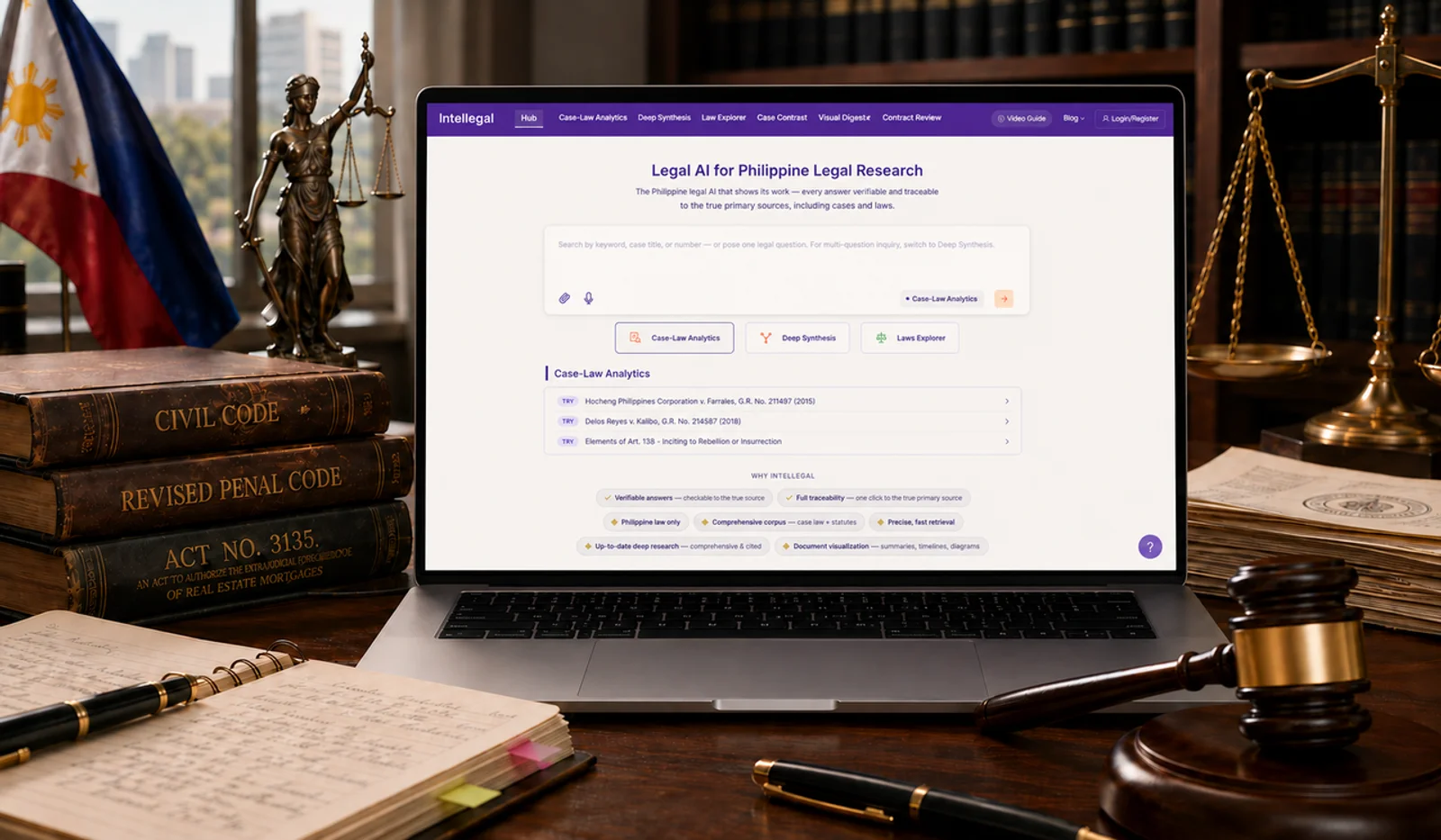
Legal research can become particularly difficult when a seemingly straightforward question depends on decades of statutes, procedural rules, and Supreme Court decisions. Intellegal is using AI to tackle that problem, combining Visual Digest, Citation Map, and Deep Synthesis to help Philippine lawyers navigate complex legal questions while keeping the underlying authorities within reach.
The platform recently put its approach to the test with a question involving extrajudicial foreclosure under Act No. 3135: when can a purchaser obtain a writ of possession, and when can a third party already occupying the property challenge that process?
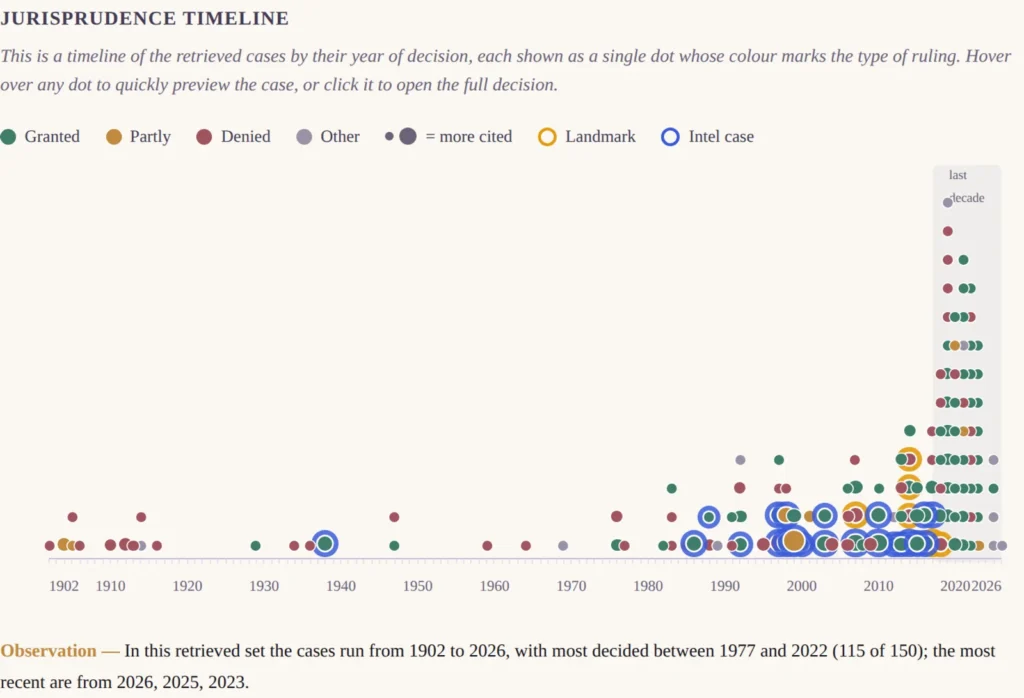
The resulting research pulled together 110 Supreme Court decisions issued between 1941 and 2023, alongside statutes, procedural authorities, and court issuances. Rather than simply producing an answer, Intellegal organized the research around the factors that could change the legal outcome.
That distinction is important in legal AI. A convincing answer is only useful if lawyers can verify where it came from.
Turning complex cases into visual research
Intellegal’s Visual Digest is designed to help lawyers quickly understand lengthy court decisions by breaking them down into timelines, arguments, legal concepts, parties, courts, and claims.

Instead of reading through an entire decision to determine whether it addresses a relevant issue, users can scan how the case progressed from the trial court to the Court of Appeals and ultimately the Supreme Court.
The tool also highlights the court’s treatment of individual grounds and legal concepts, giving lawyers a faster way to determine whether a decision is relevant before committing to a deeper read.
Mapping the authorities behind a decision
Finding one relevant case is often only the beginning of legal research. That decision may cite older cases, statutes, procedural rules, and other authorities that provide important context.
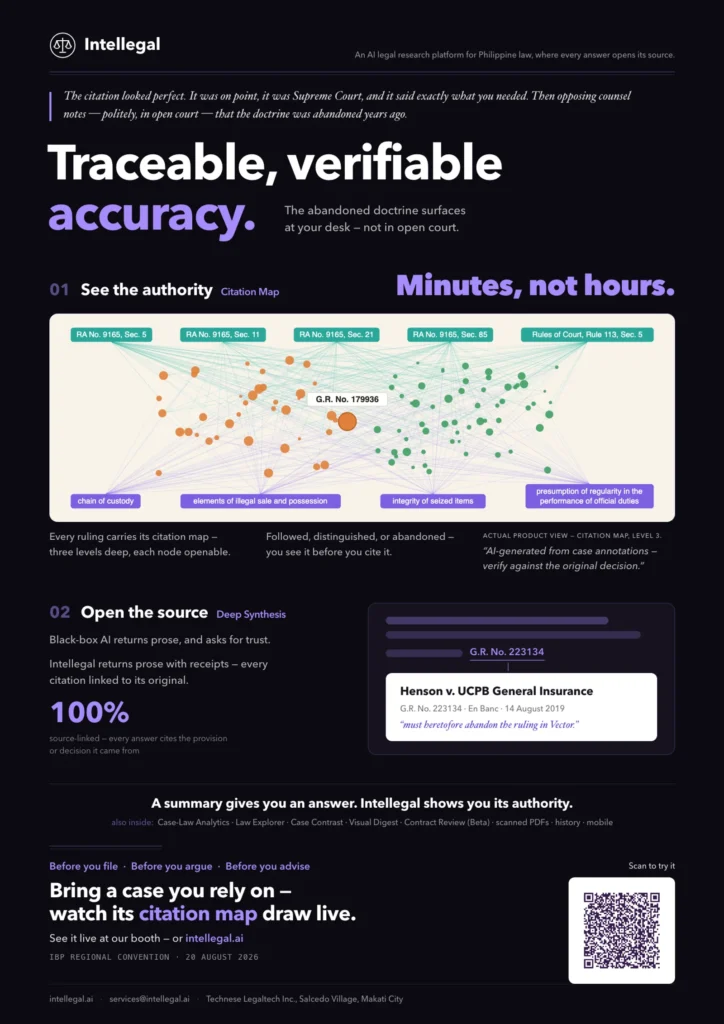
Citation Map turns those relationships into an interactive network.
Users can trace cited cases, statutes, and legal principles from a decision, with individual case nodes showing disposition types. Each case can then be opened for further review, allowing researchers to continue following the jurisprudential chain without losing sight of the original authority.
For legal practitioners, the emphasis is on traceability. Instead of accepting an AI-generated proposition at face value, users can move from the claim to the authority supporting it.
Deep Synthesis tackles the bigger questions
For more complicated legal questions, Intellegal’s Deep Synthesis takes a broader approach.
The tool breaks a research request into focused sub-questions, searches Philippine legal sources and relevant web materials, and produces an IRAC-structured report with citations tied to retrieved sources.
In the foreclosure test, the system separated the requirements applicable during the redemption period from those after ownership consolidation. It also identified the distinction between occupants whose claims derive from the mortgagor and genuine third parties asserting an independent right.
The research can then be translated into the evidence lawyers may need to examine. Depending on the side of the dispute, this could include sale records, title documents, proof of notice and publication, contracts, tax records, receipts, or other evidence establishing possession and ownership.
What the foreclosure research revealed
The 110-case research set covered 82 years of Supreme Court jurisprudence, from 1941 to 2023.
Of those decisions, Intellegal identified 22 as granted, four as partly granted, 75 as denied, and nine as other or non-merits outcomes.
The company cautions that these figures should not be treated as a prediction of how a future foreclosure dispute will be decided. A case’s disposition does not necessarily indicate who ultimately prevailed in the underlying property dispute.
Instead, the data provides lawyers with a way to see the shape of the retrieved authorities and determine where closer reading may be worthwhile.
AI as a research assistant, not a replacement for counsel
The foreclosure example highlights the broader challenge facing legal AI.
Tools such as ChatGPT can produce fluent answers but may also generate inaccurate information or citations. Enterprise platforms such as Harvey target broader legal and professional-services workflows. Intellegal, meanwhile, is positioning itself around Philippine legal research, with its tools designed to connect analysis to a dedicated legal corpus and underlying authorities.
That source connection is particularly important in legal practice, where a fabricated citation or incorrect interpretation can undermine a filing and create professional risks.
Intellegal does not claim to replace the lawyer’s judgment. It cannot determine whether a witness is credible, authenticate a document, or account for a crucial fact that was never included in the research request.
What it aims to do is shorten the distance between a difficult legal question and the authorities a lawyer needs to examine.
The promise of legal AI may ultimately be less about producing an impressive answer and more about showing exactly why that answer should—or should not—be trusted.