
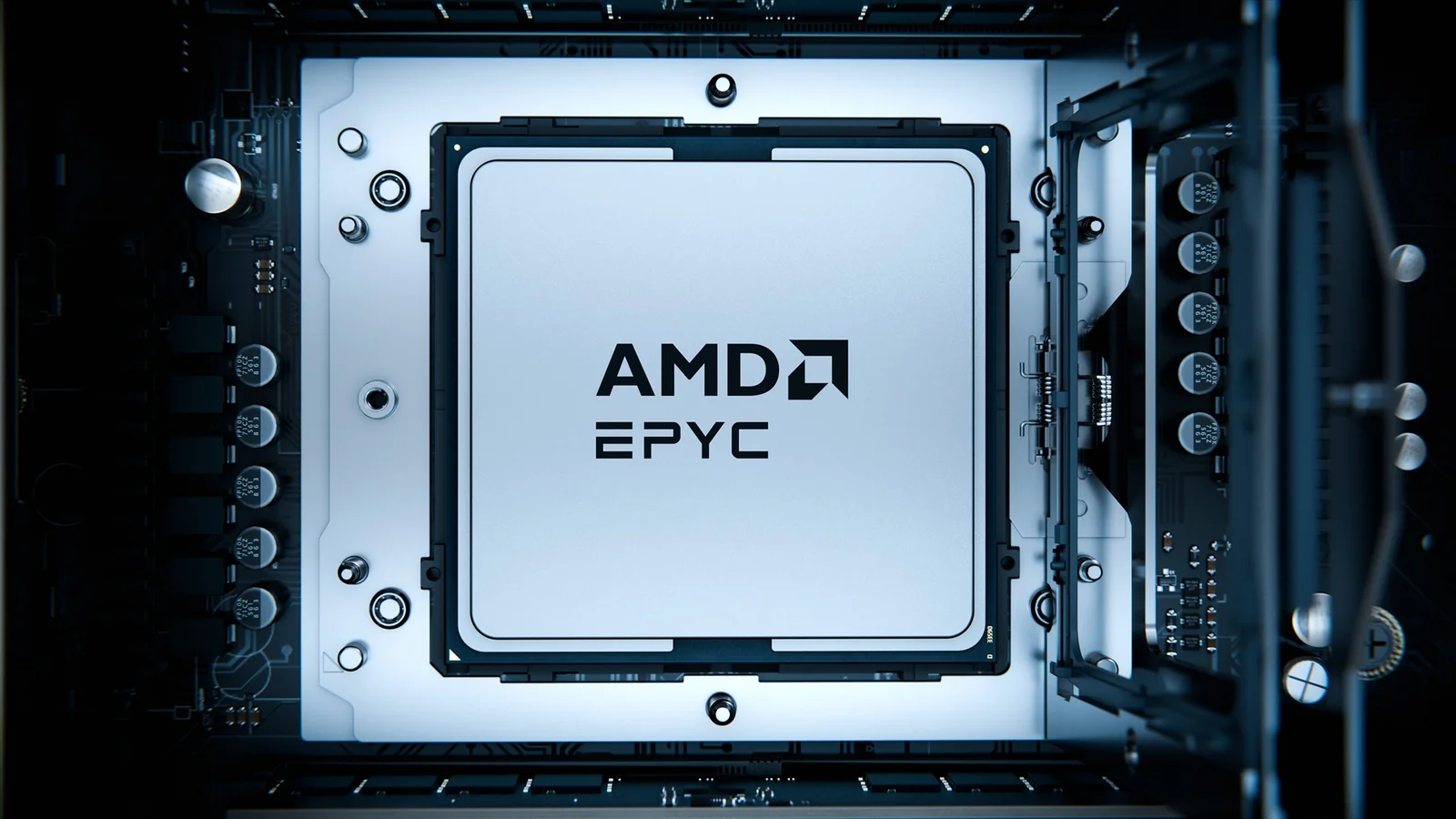
AMD has expanded its data center portfolio with the launch of the 6th Gen AMD EPYC 9006 Series server processors, introducing workload-specific CPUs designed to support the growing demands of agentic AI, enterprise applications, cloud infrastructure, and high-performance computing (HPC).
Announced during Advancing AI 2026 (AAI 2026), the new processor family is built around what AMD describes as the emerging “agentic data center,” where CPUs play a larger role alongside AI accelerators by running AI agents, feeding GPUs, and handling business-critical services that support modern AI workflows.
AMD targets the rise of agentic AI
As enterprises adopt AI systems capable of planning, reasoning, generating code, and interacting with enterprise software, AMD says CPUs are becoming increasingly important in managing these workloads alongside GPU acceleration.
According to AMD, agentic AI relies on processors to execute AI agents and spawned tasks, coordinate workloads beyond GPU processing, efficiently feed data to AI accelerators, and power enterprise applications, databases, and infrastructure services.
The company said matching CPUs to specific stages of AI workflows can improve overall throughput, system utilization, and energy efficiency across modern data centers.
“AMD EPYC processors have set the standard for leadership data center performance, efficiency and customer value, and with 6th Gen AMD EPYC server CPUs, that standard moves even higher,” said Dan McNamara, Senior Vice President and General Manager for Compute and Enterprise AI at AMD.

Four processor families target different workloads
Rather than relying on a single processor design, AMD introduced four EPYC 9006 variants optimized for specific deployment scenarios.
EPYC 9006 SP7 is designed for high-density AI environments, offering up to 256 cores and 512 threads for AI agent execution and GPU host-node workloads. High-frequency configurations reach up to 5GHz, while PCIe Gen 6 support helps accelerate communication with AI accelerators.
The EPYC 9006 SP8 family targets general-purpose enterprise deployments, with configurations ranging from 8 to 128 cores. AMD positions these processors for enterprise servers, edge computing, power-constrained environments, and smaller AI clusters where efficiency is a priority.
Built for technical computing and memory-intensive workloads, the EPYC 9006X SP7 features up to three times more L3 cache per core than standard SP7 models and clock speeds of up to 5.15GHz. According to AMD, the processors are suited for simulations, modeling, analytics, retrieval workloads, and high-performance computing (HPC) applications.
Previously codenamed Verano, the EPYC 9006 LP is purpose-built as an AI host-node processor for rack-scale AI systems. It combines LPDDR memory with clock speeds of up to 5GHz to help maintain data throughput between CPUs and increasingly dense GPU deployments.
One platform for evolving AI infrastructure
AMD says the EPYC 9006 portfolio shares a common software ecosystem and security foundation, allowing organizations to deploy different processor configurations while maintaining software compatibility across their infrastructure.
Instead of using a single processor for every workload, AMD positions the new lineup as a modular platform that lets enterprises optimize compute resources based on AI density, memory requirements, accelerator support, or traditional enterprise applications.
The launch complements AMD’s broader AI strategy unveiled at Advancing AI 2026, where the company also introduced the next-generation Instinct MI400 Series GPUs aimed at frontier AI and HPC deployments.