
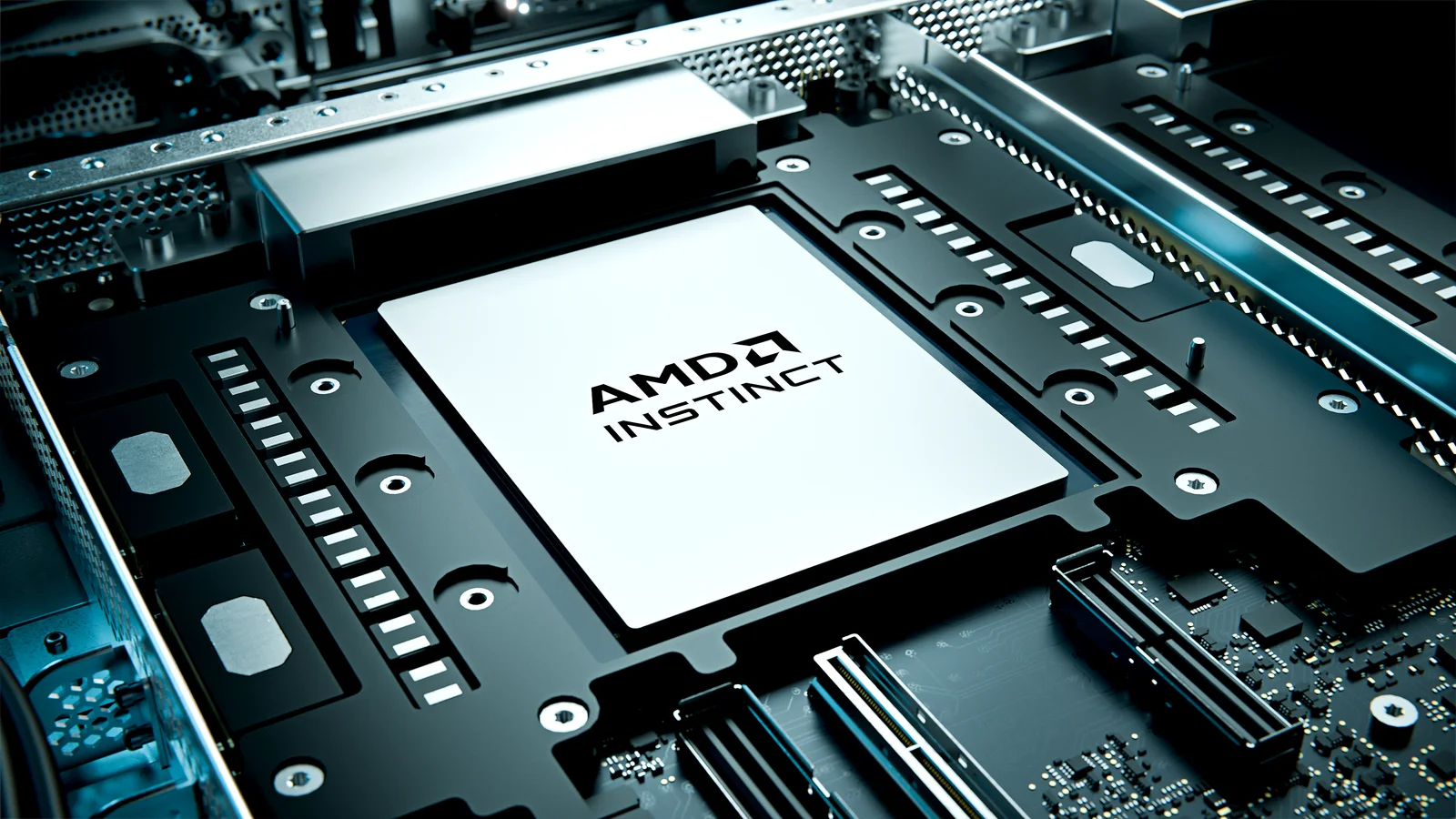
AMD has expanded its AI hardware portfolio with the launch of the AMD Instinct MI400 Series, introducing a new generation of data center GPUs built for frontier artificial intelligence (AI), sovereign AI, and high-performance computing (HPC).
Announced during Advancing AI (AAI) 2026, the new lineup includes the AMD Instinct MI455X for hyperscale AI deployments and the AMD Instinct MI430X for sovereign AI and scientific computing. Together, the GPUs aim to address the growing demand for specialized AI infrastructure while maintaining an open software ecosystem through AMD’s ROCm platform.
AMD targets hyperscale AI factories and sovereign AI deployments
Rather than offering a one-size-fits-all accelerator, AMD has split the MI400 Series into solutions tailored for different AI environments.
The AMD Instinct MI455X is designed for large-scale AI factories, supporting frontier model training, fine-tuning, and inference workloads. It also serves as the computing backbone of the newly announced AMD Helios rack-scale AI platform.
Meanwhile, the AMD Instinct MI430X focuses on sovereign AI initiatives and HPC environments, where numerical precision, long-term operational control, and security are priorities for governments, research institutions, and national computing centers.
According to AMD, the portfolio allows organizations to deploy infrastructure optimized for their workloads while maintaining software portability and interoperability.

HBM4 memory and FP64 performance drive AI and HPC workloads
The MI400 Series introduces HBM4 high-bandwidth memory, providing greater memory capacity and bandwidth to support larger AI models while reducing infrastructure complexity.
According to AMD, the MI455X delivers the compute and networking performance required for high-volume AI inference and large language model training.
Meanwhile, the MI430X is designed for scientific computing and converged AI-HPC workloads, offering up to 288 TFLOPS of hardware-based FP64 performance, high-bandwidth HBM4 memory, and increased memory throughput for processing large datasets and complex simulations.
AMD said these capabilities are intended to help organizations running research-intensive applications alongside AI workloads.
ROCm remains the foundation of AMD’s open AI strategy
Supporting the hardware is Advanced Micro Devices’s ROCm, an open software platform for AI and high-performance computing (HPC) development.
The ROCm ecosystem includes programming models, compilers, runtime environments, AI and HPC libraries, and deployment tools designed to support the development and deployment of AI workloads.
According to AMD, ROCm’s commitment to open standards helps customers avoid vendor lock-in while maintaining compatibility across hardware, networking, and software environments.
The company said this approach differs from proprietary AI ecosystems by emphasizing flexibility and long-term software portability.
Security and scalability built into the MI400 Series
AMD has also integrated additional security features across the MI400 lineup, including secure boot, encrypted GPU-to-GPU communication, and hardware-based security protections.
These capabilities help safeguard sensitive AI models and scientific workloads while supporting deployments ranging from traditional HPC clusters to rack-scale AI infrastructure such as AMD Helios.
AMD expands its AI portfolio for the next phase of enterprise AI
AMD says the Instinct MI400 Series reflects the industry’s shift toward specialized AI infrastructure as enterprises, governments, and research institutions deploy AI across increasingly diverse environments.
“The next generation of AI will span frontier AI, sovereign AI and scientific computing, and each requires infrastructure optimized for its unique demands,” said Vamsi Boppana, Senior Vice President of AI at AMD.
With the MI400 Series, AMD is broadening its AI hardware portfolio beyond hyperscale data centers, offering purpose-built GPUs designed to support everything from frontier AI factories to leadership-class HPC systems while maintaining its focus on open software and scalable infrastructure.