Lenovo introduced a new lineup of AI-powered devices and experimental form factors during Mobile World Congress 2026, highlighting the company’s vision for adaptive computing across personal and professional devices.
The announcement includes modular PC concepts, a glasses-free 3D laptop prototype, a foldable gaming handheld, and the initial rollout of Lenovo Qira—an AI system designed to work across Lenovo’s device ecosystem.
Lenovo Qira brings system-level AI across devices
A central part of Lenovo’s announcement is Lenovo Qira, described as a system-level AI experience built directly into supported devices instead of operating as a separate application.
Lenovo Qira is designed to maintain continuity between tasks across PCs, tablets, smartphones, and wearables. The system analyzes user intent to assist with workflows and device interactions.
The rollout will begin across more than 20 Lenovo devices, including products in the Lenovo Yoga, Lenovo IdeaPad, Lenovo Legion, and Lenovo ThinkPad.
Updates will be delivered through over-the-air updates and preloaded software. Lenovo also confirmed that Qira will debut on tablets with the Lenovo Idea Tab Pro Gen 2.

Initial support covers nine regions and six languages, including English, Spanish, French, Italian, German, and Portuguese. The company also plans to extend the AI system to smartphones through its subsidiary Motorola.
Lenovo explores modular PCs and spatial computing concepts
Alongside commercial products, Lenovo showcased several concept devices that explore future PC form factors.
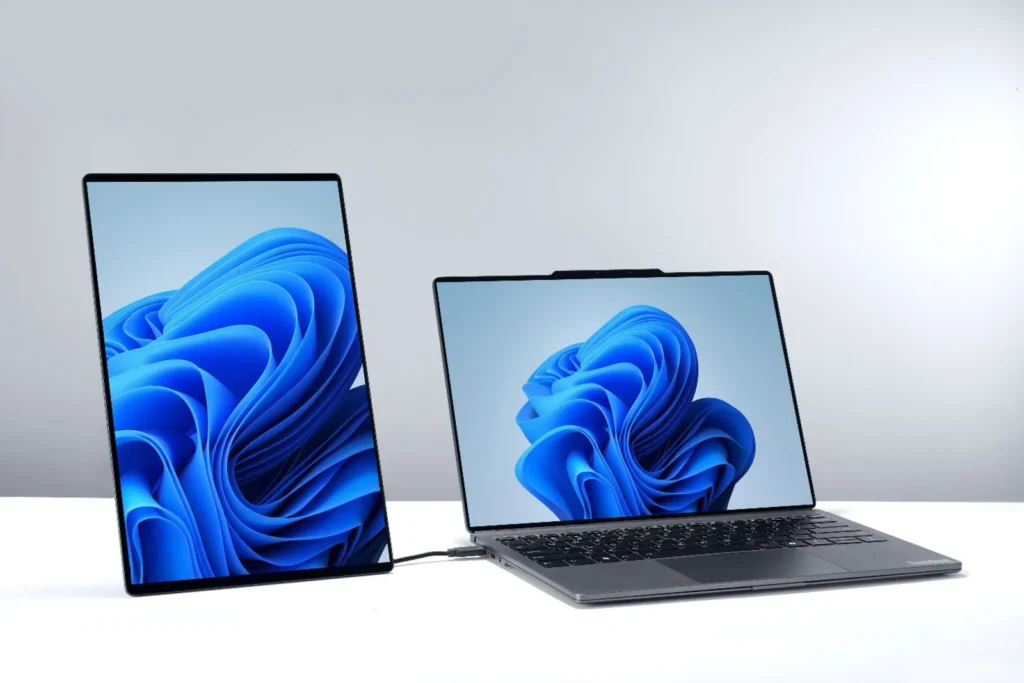
The ThinkBook Modular AI PC Concept introduces a selectively modular architecture built around a thin 14-inch base system. The design allows users to attach secondary displays, swap input modules, and expand I/O components depending on workflow needs.
A detachable secondary screen can extend the display workspace to approximately 19 inches, allowing users to create a larger multitasking environment while maintaining portability.
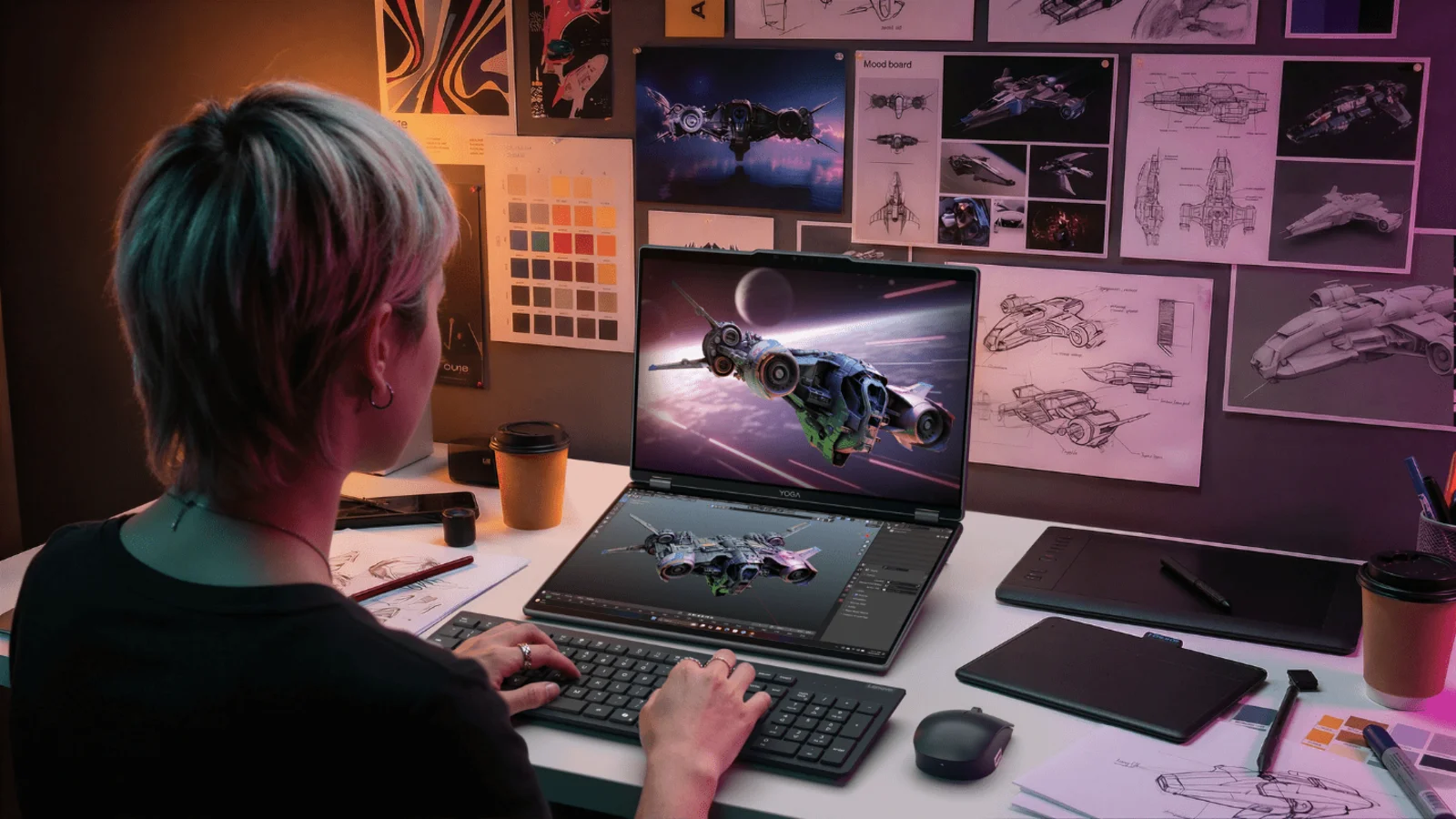
Lenovo also presented the Yoga Book Pro 3D Concept, a laptop designed for glasses-free 3D viewing. The system combines dual displays, gesture interaction, and AI-powered 2D-to-3D conversion to enable creators to view and manipulate depth directly on the screen.
Foldable Legion gaming concept highlights adaptable hardware
Lenovo’s gaming division also introduced the Legion Go Fold Concept, a foldable gaming handheld designed to support multiple usage modes.
The device can transition between a compact handheld format and a larger display for gaming or productivity. The concept supports several configurations, including handheld play, split-screen multitasking, expanded display gaming, and desktop-style interaction.
The prototype highlights how flexible display technology could merge portable gaming and productivity into a single device.
Lenovo expands AI-ready ThinkPad and consumer devices
Beyond concept hardware, Lenovo also introduced updates across its commercial and consumer PC lineup.

Within its enterprise portfolio, the company announced improvements to the ThinkPad T-Series, with a focus on repairability, serviceability, and support for AI-driven workloads. Select models achieved high repairability scores from iFixit, reflecting Lenovo’s focus on sustainability and lifecycle management.
Other commercial devices introduced include:
- ThinkPad X13 Detachable, a lightweight detachable PC with pen support
- ThinkTab X11, a rugged Android tablet for industrial and frontline environments
- ThinkBook 14 2-in-1 Gen 6, designed for small and medium businesses
Lenovo also introduced the ThinkVision M16 portable monitor, which provides a lightweight external display for mobile professionals.
Yoga, IdeaPad, and Legion devices expand AI-enabled consumer lineup
For creators, students, and gamers, Lenovo also expanded its consumer product portfolio with several new devices.
These include the Yoga 9i 2‑in‑1 Aura Edition, a convertible laptop featuring OLED visuals and AI-powered productivity tools. Additional devices such as the Yoga Pro 7a and IdeaPad Slim 5i Ultra focus on balancing performance and portability for everyday computing.
In gaming, Lenovo announced the Legion 7a gaming laptop and the Legion Tab, a compact gaming tablet equipped with a 3K display and advanced cooling system.
Lenovo pushes toward a unified AI ecosystem
Through its announcements at MWC 2026, Lenovo emphasized a broader strategy focused on AI-enabled computing across multiple device categories.
By combining adaptive hardware designs with the rollout of Lenovo Qira, the company aims to create an ecosystem where PCs, tablets, smartphones, and wearables work together through a shared AI framework.
The approach reflects a shift in personal computing toward systems that automatically adapt to user behavior, workflows, and connected devices.