
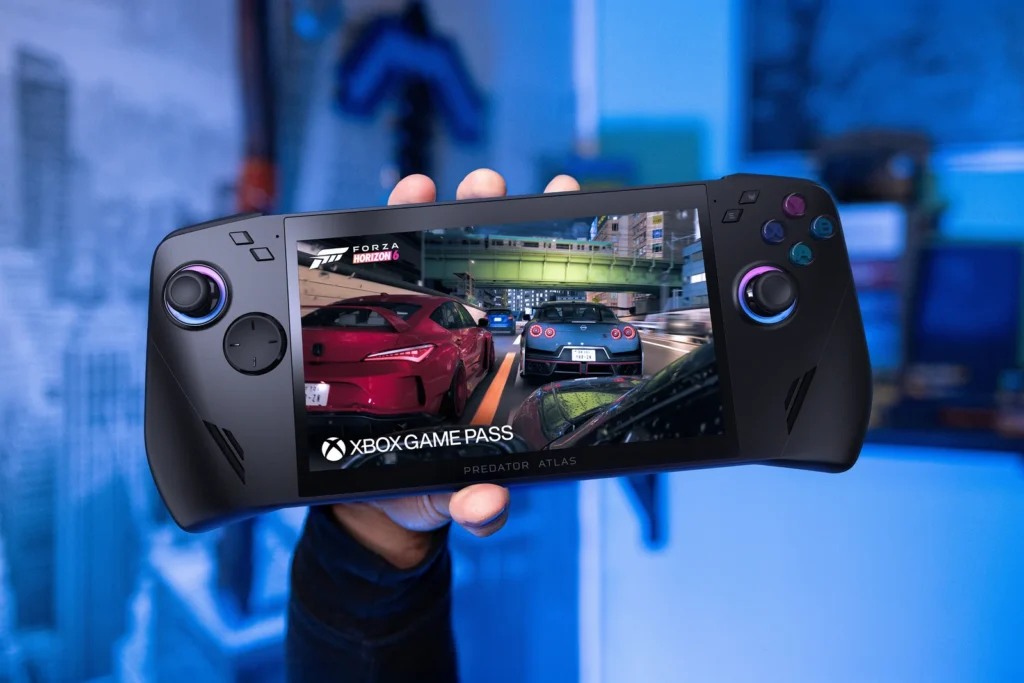
Acer is expanding its gaming handheld lineup with the Predator Atlas 7, a more compact 7-inch device that brings the performance of its larger Predator handhelds into a smaller form factor.
Unveiled at Acer’s next@acer global press conference in Berlin on September 2, the Predator Atlas 7 combines up to an Intel Arc G3 Extreme processor, Intel Arc B390 graphics, a 120Hz display, and an 80Wh battery.
Alongside the new handheld, Acer also introduced Project DualPlay Mini, an 8-inch concept device designed to combine gaming and mobile productivity in a convertible form factor.
Predator Atlas 7 packs Intel Arc performance into a 7-inch handheld
The Predator Atlas 7 (PA07-I51) is aimed at gamers who want a more portable alternative without moving away from Acer’s high-performance Predator lineup.
The handheld can be configured with up to an Intel Arc G3 Extreme processor and Intel Arc B390 graphics. Acer is also bundling access to Xbox Game Pass, giving users access to hundreds of games alongside the full Windows 11 gaming experience.
The device features a 7-inch FHD touchscreen with a 120Hz refresh rate, up to 500 nits of brightness, Variable Refresh Rate (VRR), and a 16:9 aspect ratio.

The display is protected by Corning Gorilla Glass Victus with DXC surface treatment, which is designed to improve scratch resistance and reduce glare. Acer also includes a tempered-glass screen protector.
Dual-fan cooling targets sustained gaming
Keeping a powerful processor and GPU running inside a compact handheld requires an equally capable cooling system.
The Predator Atlas 7 uses a dual-fan cooling architecture featuring an 89-blade Predator AeroBlade metal fan with blades measuring just 0.1mm thick. Acer claims the design can increase airflow by up to 10%.
A secondary plastic fan works alongside the AeroBlade fan, while Vortex Flow tuning uses angled internal channels to help direct hot air out of the chassis during sustained workloads.
The handheld is also equipped with a battery of up to 80Wh, giving users additional capacity for longer gaming sessions away from an outlet.
TMR joysticks and Hall-effect triggers target precision
Acer has also redesigned the Atlas 7 around longer gaming sessions.
The device features contoured grips, an enlarged palm-rest area, recessed keys, and an anti-slip texture intended to provide a more stable grip.
Users can also opt for Tunneling Magnetoresistance (TMR) joysticks, which Acer says provide greater precision and anti-drift performance with zero dead zones.
The handheld additionally uses Hall-effect analog triggers, giving players more control over inputs that rely on varying pressure and travel.
A built-in fingerprint reader on the power button supports quick Windows Hello authentication.

Thunderbolt 4 and Wi-Fi 7 expand connectivity
The Predator Atlas 7 isn’t limited to handheld gaming.
It comes with two Thunderbolt 4 ports for high-bandwidth docking, external displays, and accessories, while a UHS-II microSD card slot provides faster external storage expansion.
Wireless connectivity includes Intel Killer Wi-Fi 7 and Bluetooth 5.4.
Acer’s PredatorSense software provides access to system monitoring, performance modes, RGB lighting controls, and gameplay settings.
For audio, the Atlas 7 features dual 2W speakers with DTS:X Ultra, while dual microphones with Acer PurifiedVoice provide AI-assisted noise reduction for voice communication.
Project DualPlay Mini turns a handheld into a mini laptop
Acer also used its Berlin event to showcase Project DualPlay Mini, an 8-inch conceptual device that explores how a gaming handheld could double as a mobile productivity machine.
The concept uses a flip-and-swivel design that lets the device transition between handheld and mini-laptop configurations.
For gaming, users can switch between two control setups. The traditional mini-laptop configuration uses a built-in backlit physical keyboard, which Acer specifically positions for first-person shooter games.
The handheld configuration, meanwhile, provides a more conventional console-style control experience for other genres.
When it’s time to work, Project DualPlay Mini can function as a mobile productivity device and connect to an external display.
Acer marks 50 years with an experimental form factor
Project DualPlay Mini also carries a small detail commemorating Acer’s 50th anniversary. The back cover features “Acer 50 since 1976” embedded in Morse code, combining the company’s anniversary with the Predator brand’s gaming-focused identity.
The concept also uses a dual-fan cooling architecture derived from the Predator Atlas 8, including a Predator AeroBlade metal fan and a secondary plastic fan.
Unlike the production-focused Atlas 7, however, Project DualPlay Mini remains a concept device, with Acer using it to explore the overlap between gaming hardware and mobile productivity.
With the Predator Atlas 7, Acer is instead taking a more conventional approach to the growing gaming handheld market: shrink the flagship experience into a more portable 7-inch device while retaining high-end Intel Arc graphics, active cooling, a large battery, and PC-level connectivity.