
As enterprises move toward agentic AI systems, the conversation is shifting away from isolated chip performance and toward how much usable computing capacity can fit inside a data center rack.
AMD is positioning its EPYC processor lineup at the center of that shift, arguing that production AI workloads depend less on GPU acceleration alone and more on CPU-heavy infrastructure that powers orchestration, databases, APIs, and middleware services.
Agentic AI is increasing pressure on CPU infrastructure
While AI discussions often focus on GPUs, real-world agentic systems rely heavily on traditional CPU-driven workloads.
These include orchestration and control-plane services, databases and transactional systems, web and API servers, caching and middleware layers, and distributed service coordination.
Unlike model training or inference, these workloads scale based on the number of active agents and services rather than model size, making CPU capacity a key constraint in production environments.
AMD’s positioning reflects this shift, framing CPUs as foundational infrastructure for scalable AI deployment, especially in environments where system coordination and service reliability matter more than raw model compute.

Rack-level performance becomes the defining metric
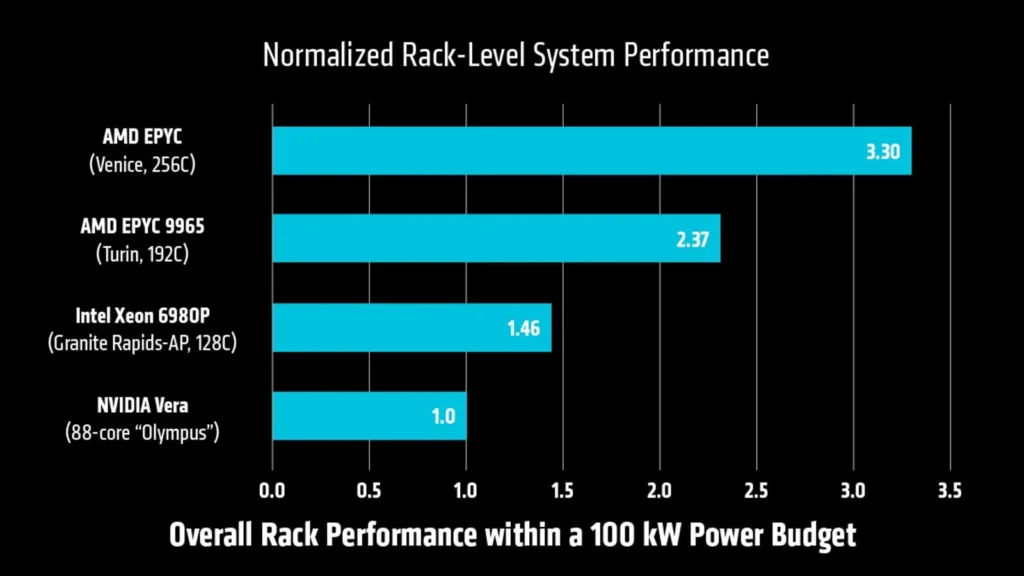
Instead of measuring performance through single-chip benchmarks, AMD’s analysis focuses on rack-level throughput under power and thermal limits, particularly in a modeled 100kW rack environment.
This approach reflects how data centers are actually deployed, where constraints include power consumption per rack, cooling capacity, physical space, software compatibility, and operational scalability.
Within this framework, AMD compares its EPYC processors against competing platforms, arguing that rack-level efficiency—not peak CPU speed—determines real deployment capacity for enterprise workloads, especially in large-scale AI and cloud infrastructure environments.
Higher-density CPU deployments drive throughput gains
AMD’s EPYC 9965 (“Turin”) is positioned as a high-density server processor designed for multi-workload environments common in AI infrastructure stacks.
Across a range of infrastructure workloads—including web services, Java applications, key-value stores, and database operations—AMD reports higher aggregated throughput at the rack level compared to competing CPU platforms.
The company also projects further gains with its next-generation EPYC “Venice” architecture, driven primarily by increased core density within the same power envelope.
The underlying trend is straightforward: more cores within a fixed rack budget translate to higher concurrent service capacity.
CPU density becomes a scaling factor for AI systems
As AI systems evolve into continuously running agent-based architectures, CPU scaling becomes a limiting factor for overall system size.
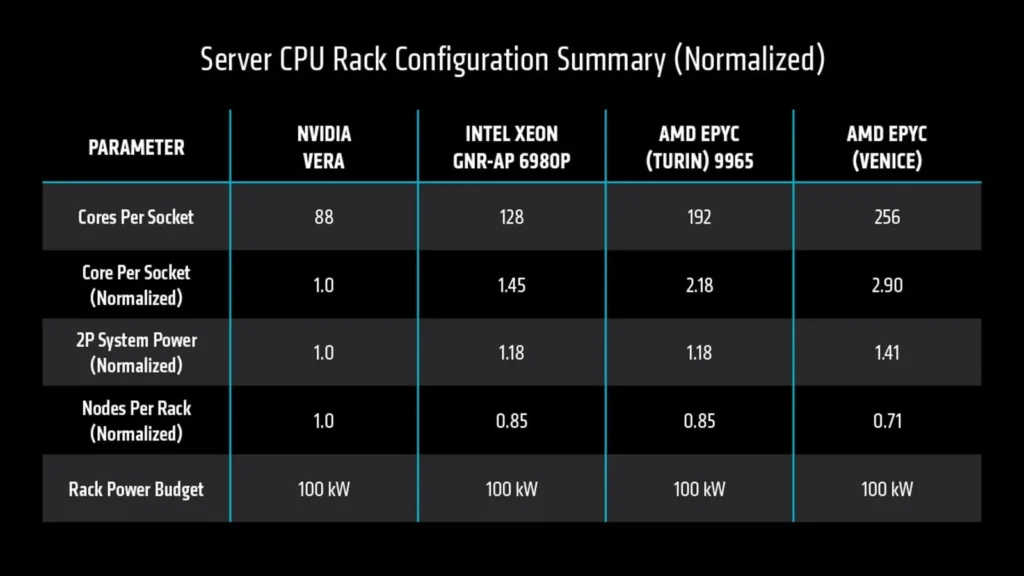
AMD highlights that increasing core density allows higher concurrency for AI agents, improved responsiveness across services, better utilization of fixed rack power budgets, and reduced infrastructure footprint per workload.
This makes CPU platforms a critical part of scaling AI beyond isolated deployments into full production environments, reinforcing how AMD positions its EPYC ecosystem as foundational infrastructure for modern AI-driven data centers.
Standards-based infrastructure remains a key advantage
A major part of AMD’s argument centers on deployability.
EPYC platforms are built on standard x86 infrastructure, allowing enterprises to scale without introducing new system architectures or major software changes. This reduces integration friction and enables faster adoption across existing data center environments.
In contrast to experimental or future-focused architectures, AMD is positioning its EPYC lineup as production-ready infrastructure available today.
Conclusion: AI scaling is becoming an infrastructure problem, not just a compute race
As agentic AI moves into enterprise production, infrastructure planning is increasingly defined at the rack level rather than the processor level.
AMD EPYC’s positioning reflects this shift, focusing on throughput, density, and compatibility within real-world data center constraints.
In this context, CPU performance is no longer just about raw speed—it becomes a measure of how much operational AI infrastructure can be deployed, sustained, and scaled within a fixed physical footprint.