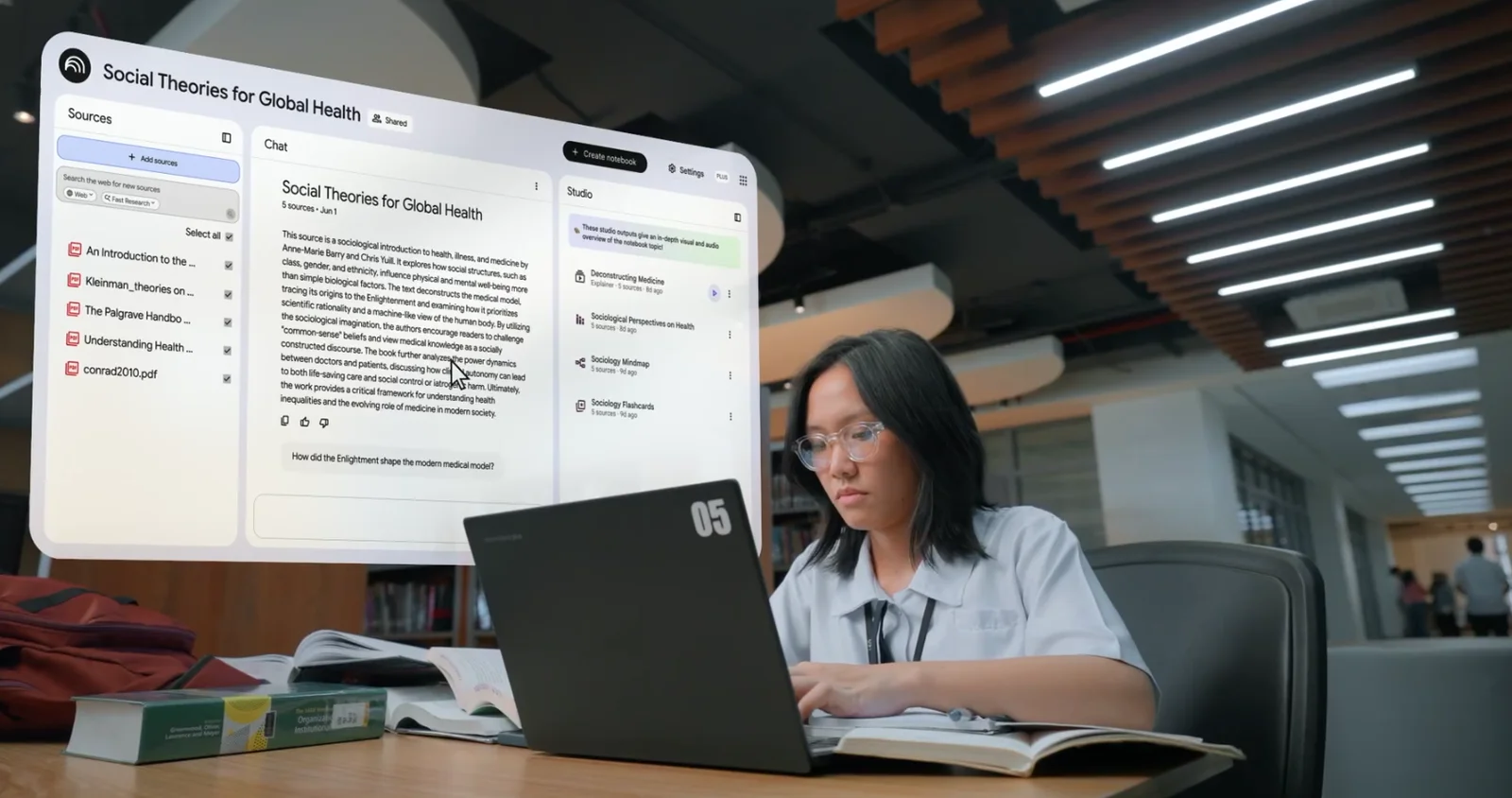
The University of Santo Tomas (UST) is expanding the use of generative AI across its campus, training more than 2,000 faculty members to use Google’s Gemini tools in teaching and learning.
The rollout of Gemini for Education spans UST’s 22 degree-granting academic units and supports a student population of around 46,000, as the university looks to integrate AI without losing the critical thinking, creativity, and human interaction at the center of education.
UST puts faculty training at the center of AI adoption
UST’s AI push builds on its earlier adoption of Google Workspace for Education, followed by the campus-wide deployment of Gemini and Gemini Notebook.
Rather than treating AI as a replacement for conventional instruction, UST’s Educational Technology Center (EdTech) has focused on helping faculty use the technology according to the needs of their respective disciplines.
The university trained more than 2,000 faculty members, while 45 e-learning specialists embedded across different colleges help adapt AI tools to specific classroom requirements. More than 300 Google Certified Educators also support the broader technology ecosystem.
“At the Educational Technology Center, our mandate is to integrate technology tools for teaching, learning, research, and community service,” said Asst. Prof. April Joy M. Gascon, Acting Director of the UST EdTech Center.

Gemini takes different roles across UST classrooms
UST’s implementation highlights how generative AI can serve different purposes depending on the subject.
In nursing, faculty use Gemini to create realistic patient-care scenarios that allow students to practice emergency decision-making before entering actual hospital environments.
Architecture students and professors, meanwhile, use AI visualization to turn concepts into realistic renders, including designs inspired by vernacular Philippine architecture.
In engineering, instructors create dynamic visualizations of mathematical formulas to help students understand concepts such as spatial coordinates.
For Theology, students use Gemini Notebook to synthesize dense historical and philosophical materials into study resources, allowing classroom discussions to spend more time on ethics and human values.
The university said these applications are intended to support instruction rather than replace the expertise of educators.
AI cuts preparation time for educators
UST is also using Gemini for tasks outside direct classroom instruction, particularly repetitive preparation work.
Faculty can use AI to help draft lesson plans, rubrics, visual guides, flashcards, quizzes, and other learning materials, reducing the amount of time spent on routine preparation.
The university sees the time savings as an opportunity for educators to focus more on mentorship, personalized feedback, and face-to-face engagement with students.
“Ever since we started using Google AI, classroom dynamics have changed for the better because students can now demonstrate their learning in transformative ways,” said Shane Alexander Y. Laong, Team Leader for E-Learning Specialists at UST.
He added that Gemini Notebook has helped teachers and students turn large volumes of literature into flashcards, quizzes, and review materials.
UST sets responsible AI guidelines
UST’s AI rollout also includes guidelines intended to protect academic integrity and ethical standards as students and faculty incorporate generative AI into their work.
The university’s approach places responsible use alongside technical adoption, with educators encouraged to understand how AI affects instruction and redesign learning activities accordingly.
“I strongly encourage my fellow educators to set aside their fears of AI. Understand what it does, understand its impact on instruction, and redesign teaching to make it more purposeful and relevant for students,” said Prof. Cheryl R. Peralta, DrPH, UST Vice Rector for Academic Affairs.
The broader goal, she said, is to prepare Thomasian graduates to use critical thinking, problem-solving, and AI ethically and responsibly.
As AI tools become increasingly common in education, UST’s rollout illustrates a shift from simply providing students with access to generative AI toward training educators to integrate it into discipline-specific learning.