
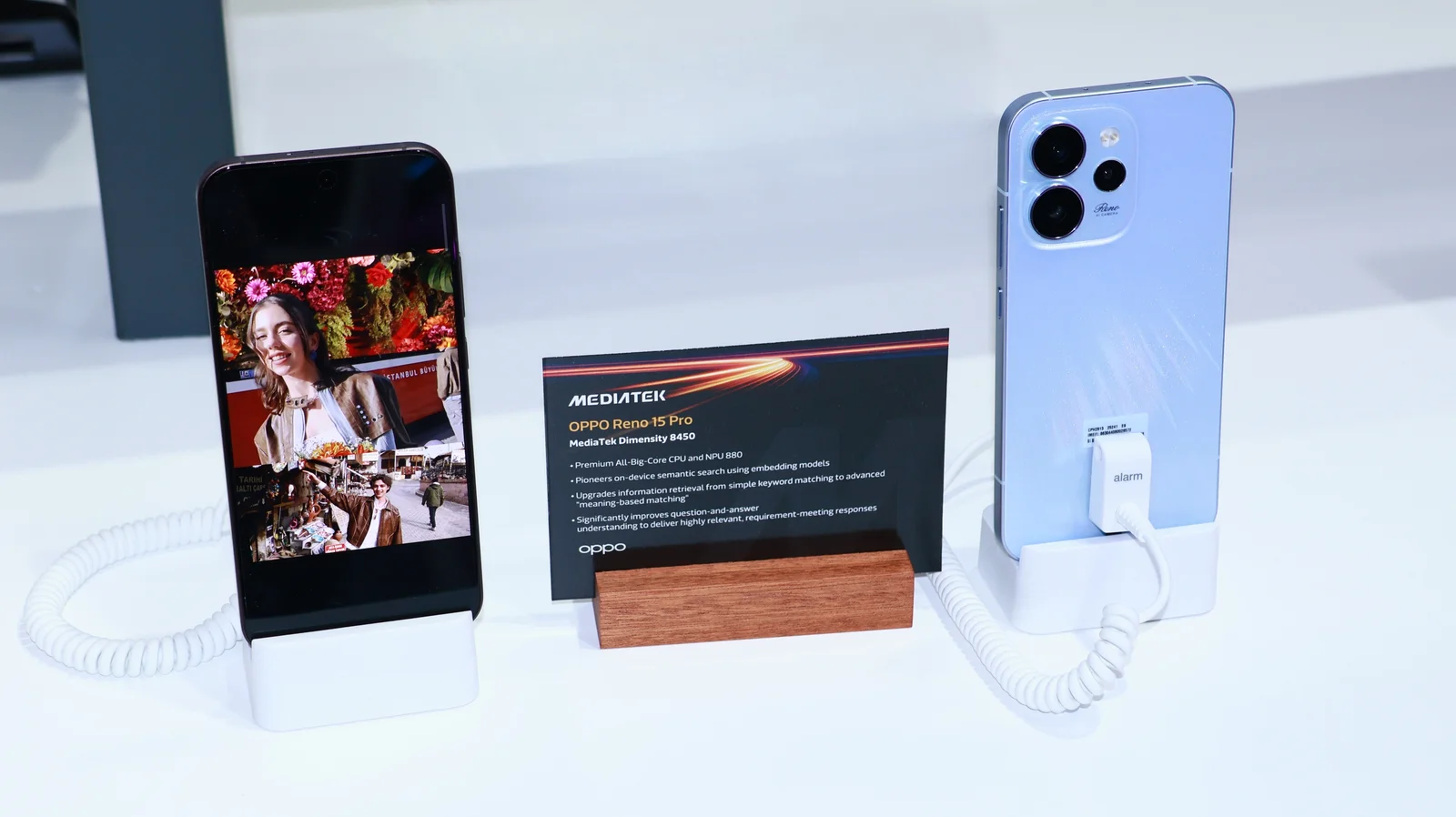
At Mobile World Congress 2026 in Barcelona, OPPO and MediaTek demonstrated new on-device artificial intelligence capabilities aimed at making AI features faster, more private, and more accessible on smartphones.
The two companies presented the developments during MediaTek’s “AI for Life” keynote, where Jason Liao, president of the OPPO Research Institute, outlined how their collaboration is accelerating the rollout of AI-powered mobile experiences.
The showcase included new on-device AI tools, progress on the Omni multimodal AI model, and improvements in cross-ecosystem device connectivity, offering a glimpse into how next-generation AI phones could function without heavy reliance on cloud processing.
OPPO pushes on-device AI processing
OPPO said its AI strategy focuses on three pillars: New Computing, New Perception, and New Ecosystem. Central to that approach is on-device computing, which allows AI features to run directly on smartphones rather than relying entirely on cloud servers.
According to Liao, this shift enables real-time responses, stronger privacy protection, and personalized user experiences.

“On-device Compute is a cornerstone of OPPO’s AI strategy, making AI a perceptible, real-time experience integrated into everyday usage,” Liao said during the keynote.
The latest AI capabilities are powered by the MediaTek Dimensity 9500 platform and are expected to arrive on the upcoming OPPO Find X9 through the next major software update, ColorOS 16.
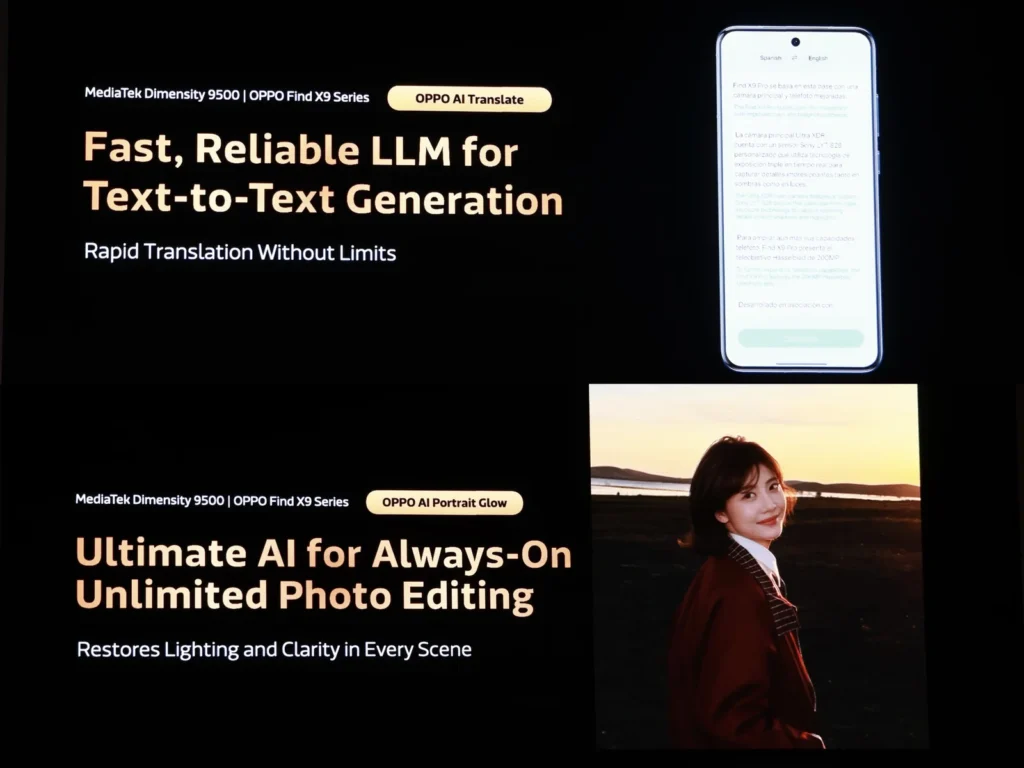
AI Translate and AI Portrait Glow run directly on-device
Among the features demonstrated were AI Translate and AI Portrait Glow, both designed to perform complex tasks locally on the device.
AI Translate allows multilingual translation without relying on an internet connection. OPPO said the feature delivers around 15 percent higher accuracy compared to conventional approaches, while maintaining stable performance even in weak signal environments.
Meanwhile, AI Portrait Glow focuses on improving portrait photography in difficult lighting conditions. The system analyzes scene lighting and reconstructs illumination to produce more balanced portraits in dim or backlit environments.
Because the processing happens directly on the smartphone, the feature works without sending image data to the cloud, which also improves privacy and response time.
Omni AI model brings multimodal understanding
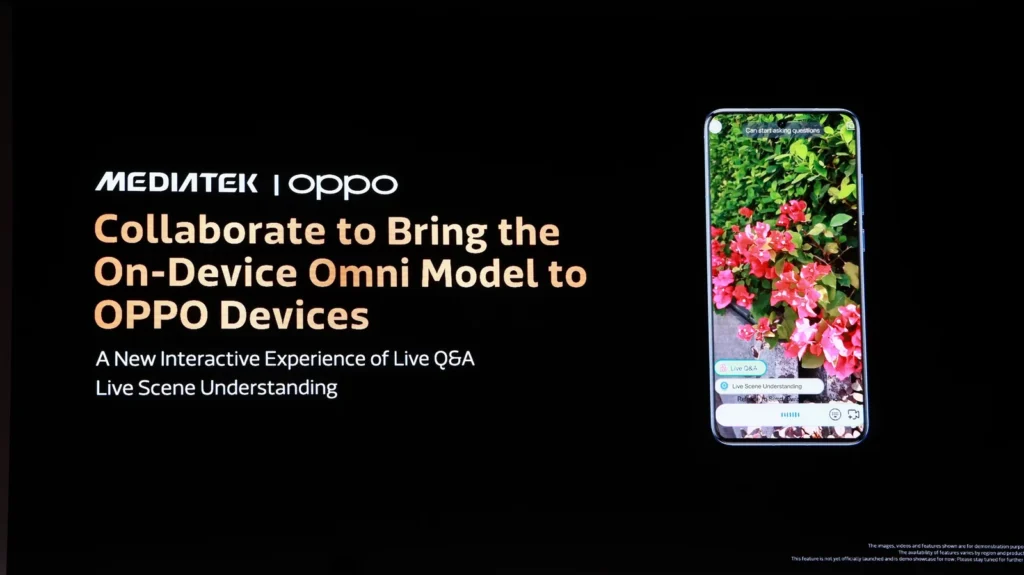
The companies also previewed Omni, which they describe as the first on-device full-modal AI model designed for smartphones.
Omni supports voice, text, and video inputs, allowing devices to understand and interpret real-world scenes in real time. During demonstrations, the system analyzed live camera input and responded to questions about objects and surroundings directly on the device.
The companies say this capability could help smartphones better interpret their environment and enable more natural human–computer interactions, particularly in AI assistants and contextual search tools.
Cross-device connectivity also expands
Beyond AI features, the companies also demonstrated ecosystem integration during the event.
At the MediaTek booth, attendees were able to test the OPPO Find X9 Pro and its AI capabilities alongside imaging features such as the OPPO Hasselblad Teleconverter. The OPPO Reno15 Pro was also showcased with creative tools including AI Motion Photo Eraser, AI Motion Photo Popout, and AI Flash Photography.
OPPO also confirmed that the Find X9 series will soon support Android Quick Share, developed with Google and MediaTek. The feature will allow users to transfer files between OPPO devices and Apple platforms, including iOS, iPadOS, and macOS, without installing third-party apps.
The update is expected to begin rolling out via software update starting in March.
Find X9 Pro earns recognition at MWC
During the event, the OPPO Find X9 Pro was shortlisted for the Best Smartphone category at the Global Mobile Awards, recognizing its advancements in performance, imaging, and AI integration.
OPPO said it will continue working with MediaTek to develop new AI technologies and bring more powerful on-device intelligence to smartphones in the coming years.