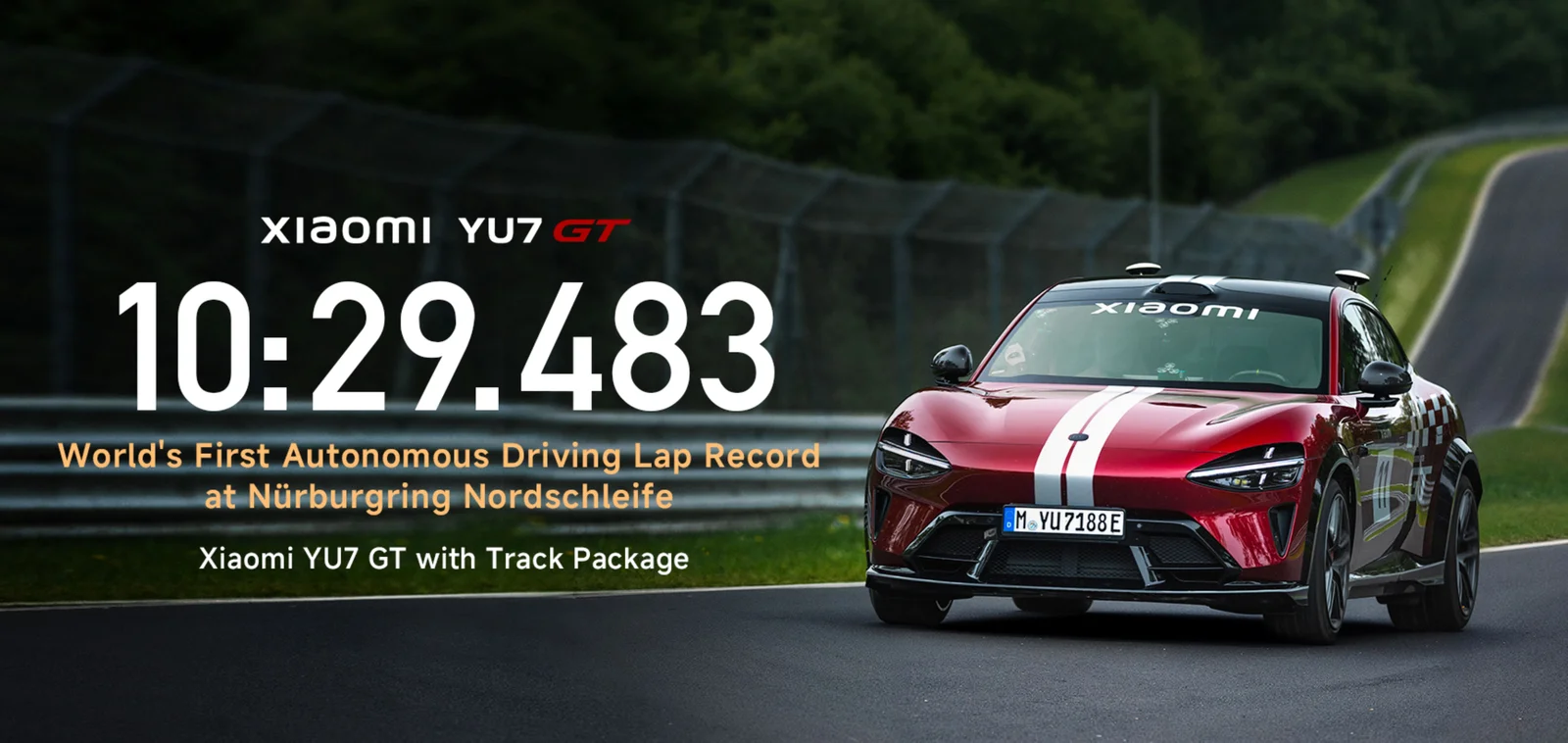
Xiaomi EV has achieved a new milestone in autonomous driving after its Xiaomi YU7 GT became the first vehicle to complete an officially certified autonomous lap of the Nürburgring Nordschleife. The achievement has prompted the German circuit to introduce a new AUTONOMOUS DRIVING category under its electric vehicle records.
The autonomous run highlights Xiaomi’s progress in AI-powered driving systems as the company continues to expand beyond smartphones and consumer electronics into the automotive industry.
Xiaomi YU7 GT completes 20.8-kilometer lap without a driver
During the test, a Xiaomi YU7 GT equipped with the Track Package completed the entire 20.8-kilometer Nürburgring Nordschleife without human intervention.
The vehicle recorded an official lap time of 10:29.483, with the run conducted and certified using the Nürburgring’s official timing procedures.
The achievement marks the first officially recognized autonomous driving lap on the historic German circuit, leading the Nürburgring to establish a dedicated autonomous driving category for electric vehicles.
One of the world’s toughest proving grounds
Often regarded as one of the world’s most demanding racing circuits, the Nürburgring Nordschleife spans 20.8 kilometers and features 73 corners, approximately 300 meters of elevation change, constantly varying road surfaces and grip levels, as well as a combination of high-speed straights and technical corner sequences.

Throughout the lap, the Xiaomi YU7 GT autonomously managed steering, braking, acceleration, and vehicle positioning across the circuit’s demanding layout without any driver input.
The test was designed to demonstrate how autonomous driving systems perform under extreme dynamic conditions, extending validation beyond conventional public-road testing. By evaluating the technology on one of motorsport’s most challenging circuits, Xiaomi EV showcased the system’s ability to handle complex driving scenarios involving rapid elevation changes, varied grip conditions, and continuous high-speed cornering.
Xiaomi advances its autonomous driving platform
The Nürburgring demonstration builds on Xiaomi EV’s continued investment in autonomous driving technology following the introduction of Xiaomi HAD in 2024.
Earlier this year, the company unveiled its next-generation autonomous driving platform based on the Xiaomi XLA architecture and the MiMo-Embodied foundation model.
According to Xiaomi, the latest platform improves environmental understanding, vehicle state analysis, dynamic traffic interpretation, autonomous decision-making, and vehicle control under complex driving conditions.
Rather than relying primarily on behavior imitation, Xiaomi says the system is designed to develop a deeper understanding of its surroundings before making driving decisions. This approach reflects a broader shift in autonomous driving development, where AI models are increasingly focused on interpreting real-world environments and responding to changing road conditions instead of simply replicating previously observed driving behavior.
AI manages vehicle dynamics in real time
Xiaomi’s autonomous driving platform combines an end-to-end architecture with vehicle dynamics modeling to continuously assess road conditions and vehicle behavior in real time.
During high-speed driving, the system simultaneously coordinates steering, braking, power delivery, and stability management to maintain vehicle control across changing driving conditions.
According to Xiaomi EV, the Nürburgring project also provides valuable data for refining its vehicle dynamics models, optimizing control strategies, and strengthening safety redundancy in future autonomous driving systems.
By validating its technology under demanding track conditions, Xiaomi aims to accelerate the development of autonomous driving capabilities that can better handle complex vehicle dynamics while improving overall system reliability and safety.
Supporting future autonomous mobility
As automotive manufacturers increasingly integrate artificial intelligence into vehicle development, testing under extreme conditions has become an important part of validating autonomous driving systems.
Xiaomi said data collected from the Nürburgring project will support further development of its autonomous driving technology as it continues to improve safety, vehicle control, and intelligent mobility for future electric vehicles.