TP-Link has announced the Archer 8, the company’s first router platform built around the upcoming Wi-Fi 8 standard, signaling its next push toward more stable and reliable home networking.
Set to launch globally in October 2026, the Archer 8 is based on the emerging IEEE 802.11bn specification, which shifts the focus of next-generation Wi-Fi away from peak theoretical speeds and toward consistent real-world performance.
The announcement also marks the beginning of TP-Link’s broader Wi-Fi 8 ecosystem strategy spanning routers, mesh systems, travel routers, and adapters.
TP-Link shifts focus from speed to reliability
With modern households now supporting dozens of connected devices simultaneously, TP-Link said future wireless technologies need to prioritize reliability under everyday conditions rather than raw throughput numbers alone.
The TP-Link Archer 8 aims to address common networking issues such as inconsistent speeds across rooms, congested multi-device environments, unstable mesh handoffs, gaming and streaming latency spikes, and weak performance through walls and multiple floors.
According to TP-Link, the platform was engineered specifically for dense home environments where interference, structural obstacles, and device saturation often affect performance more than theoretical bandwidth limits.

Early Wi-Fi 8 testing shows performance gains
TP-Link also shared early internal lab testing comparing prototype Wi-Fi 8 implementations against Wi-Fi 7 under simulated real-world home conditions.
The company reported several improvements tied to protocol enhancements and RF optimizations, including up to 33% higher throughput through improved modulation and coding, up to 24% throughput gains using unequal modulation technologies, up to 15% improvement in interference-heavy multi-access-point environments, and up to 30% signal performance improvement in multi-floor homes, along with 1–3 dB better receive sensitivity on 5 GHz and 6 GHz bands.
These improvements are designed to help maintain stronger and more stable connections, particularly in homes with multiple active devices, mesh nodes, and high-bandwidth applications running simultaneously.
While Wi-Fi 8 is still in development and not yet finalized as a standard, TP-Link’s announcement positions the company among the earliest consumer networking brands publicly outlining its Wi-Fi 8 roadmap.
Archer 8 combines premium hardware and AI-assisted networking
Beyond wireless performance, TP-Link is also positioning the TP-Link Archer 8 as a premium flagship networking product.
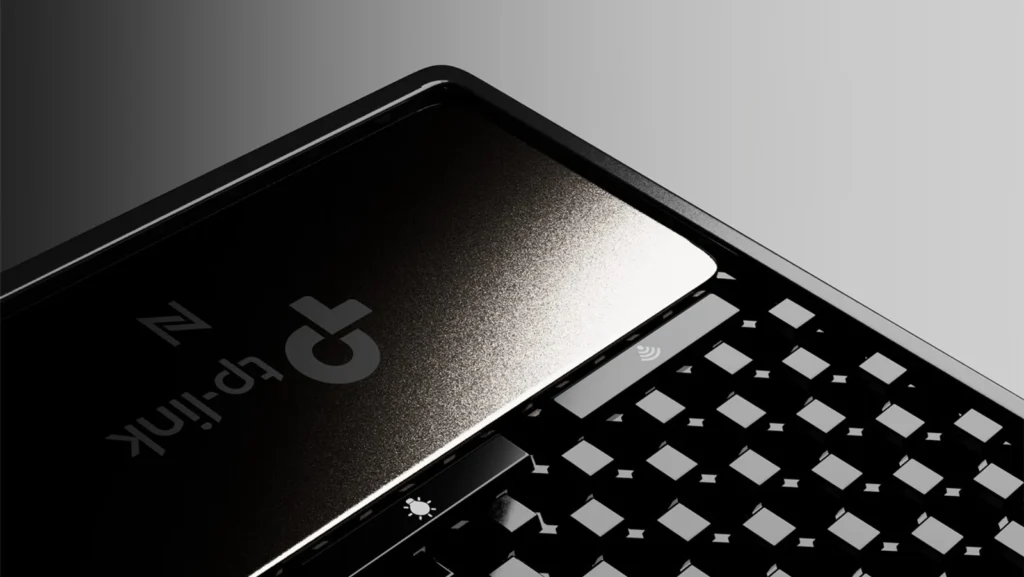
The router features a minimalist industrial design paired with advanced thermal engineering, upgraded antenna architecture, and AI-assisted optimization systems intended to improve stability and signal consistency.
TP-Link said the platform integrates advanced RF optimization, AI-assisted network intelligence, enhanced thermal management, and performance-focused antenna architecture.

The company is betting that future networking upgrades will increasingly depend on intelligent traffic handling and environmental optimization rather than speed increases alone.
TP-Link outlines broader Wi-Fi 8 ecosystem roadmap
The TP-Link Archer 8 is only the first device in TP-Link’s planned Wi-Fi 8 lineup.
The company also confirmed several upcoming products under the same platform strategy, including the Archer 8 Wi-Fi 8 Router in October 2026, the Deco 8 Wi-Fi 8 Mesh System in Q1 2027, the Roam 8 Wi-Fi 8 Travel Router in Q2 2027, and Wi-Fi 8 range extenders and adapters also arriving in Q2 2027.
This roadmap reflects how networking brands are already preparing for the next transition cycle following the rollout of Wi-Fi 7 devices across premium consumer markets.
As connected homes continue adding AI devices, smart appliances, streaming systems, and cloud gaming setups, TP-Link is increasingly positioning reliability and latency management as the next major battleground for home networking.