
AMD is expanding its Ryzen AI Embedded P100 Series processor lineup to support next-generation industrial systems and AI-driven edge computing. The new processors are designed to deliver higher CPU core counts, stronger AI acceleration, and improved graphics performance within the same compact embedded footprint.
The update targets industries such as factory automation, robotics, and medical imaging, where systems require real-time AI processing, long-term reliability, and consistent performance in always-on environments.
Higher CPU, GPU, and AI Performance for Edge Systems
The expanded AMD Ryzen AI Embedded P100 Series introduces several performance improvements compared with earlier models in the lineup.
Key enhancements include:
- Up to 2× higher CPU core counts
- Up to 8× higher GPU compute performance
- Around 36% higher total system AI performance (TOPS)
The processors feature eight to 12 “Zen 5” CPU cores, along with RDNA 3.5 graphics and a neural processing unit based on XDNA 2 architecture. Together, these components allow the chip to deliver up to 80 system TOPS for AI acceleration.
By integrating CPU, GPU, and NPU capabilities in a single chip, AMD aims to simplify hardware designs for edge systems while maintaining low-latency AI inference and real-time data processing.

Built for Industrial and Always-On Environments
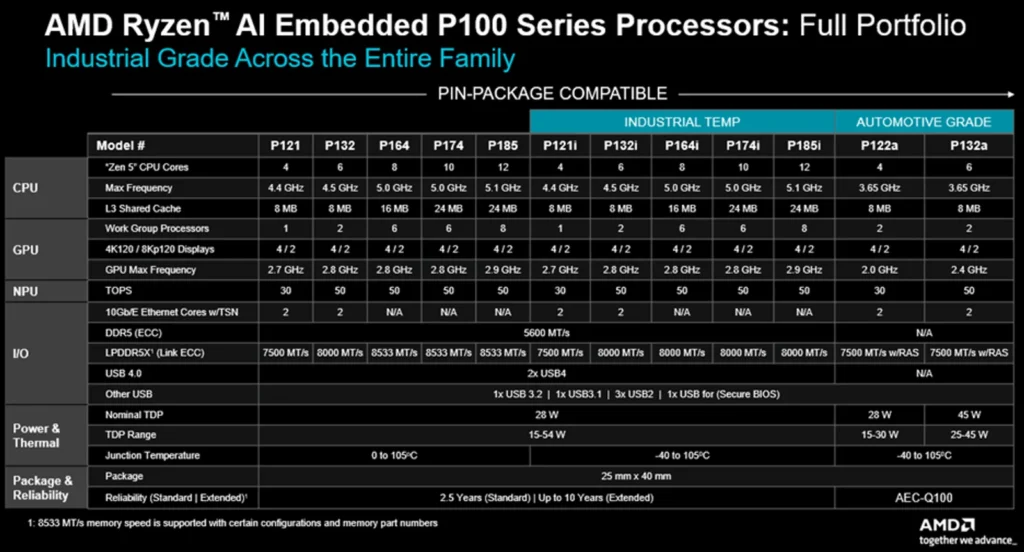
Unlike consumer processors, embedded platforms must operate reliably in demanding conditions. The P100 Series supports industrial temperature ranges from -40°C to 105°C, making it suitable for deployment in manufacturing facilities and outdoor equipment.
Other key features include:
- 24/7 operational reliability
- 10-year product life cycles
- Support for multiple virtual machines and mixed workloads
These capabilities allow manufacturers to consolidate several workloads onto a single embedded system while maintaining predictable performance.
Supporting Industrial Automation and Robotics
One major use case for the processors is intelligent factory automation. The P100 Series can consolidate multiple industrial computing roles into a single industrial PC, including programmable logic controllers (PLCs), machine vision systems, and human-machine interface (HMI) dashboards.
The integrated GPU and NPU help accelerate tasks such as:
- Multi-camera machine vision
- Real-time inspection systems
- AI-based anomaly detection
- Process optimization in manufacturing lines
In robotics, the processors can manage navigation, motion control, and route planning while also processing sensor and camera data for spatial awareness and object detection.
This capability supports advanced robotics systems used in warehouses, logistics centers, and autonomous industrial environments.
Edge AI for Medical Imaging and Healthcare
Another target sector is healthcare technology, particularly edge-based medical imaging systems.
The processors can support applications such as:
- 3D imaging in ultrasound and endoscopy
- Tissue classification and tumor detection
- AI-assisted clinical diagnostics
- Automated image-to-report workflows
For medical device manufacturers, the ability to run imaging analysis and AI models directly on the device reduces reliance on cloud infrastructure and improves response time for critical diagnostics.

ROCm Software Support for AI Development
The expanded P100 lineup also introduces support for AMD ROCm, AMD’s open-source software stack for high-performance computing and AI development.
ROCm enables developers to run standard machine learning frameworks while leveraging open-source compilers, libraries, and runtime tools. It also supports the Heterogeneous-computing Interface for Portability (HIP), which helps reduce dependency on proprietary programming frameworks.
This open ecosystem allows developers to build AI applications that can scale across different hardware platforms without major code rewrites.
Growing Industry Adoption
Several embedded system manufacturers have already started developing products based on the P100 Series platform.
Companies such as Advantech, congatec, and Kontron are introducing solutions that incorporate the processors into computer-on-modules, single-board computers, and edge AI systems.
These hardware platforms will allow industrial OEMs to deploy scalable AI solutions across automation, robotics, and smart infrastructure environments.
Answering the demands for AI computing
Edge AI is rapidly becoming a key part of industrial digital transformation. Instead of sending data to centralized cloud systems, many companies now process data locally on devices to reduce latency, improve reliability, and enhance data privacy.
By integrating CPU, GPU, and NPU capabilities in a compact embedded processor, AMD’s Ryzen AI Embedded P100 Series aims to accelerate the adoption of AI-powered industrial systems, from smart factories to autonomous robotics and medical devices.
As demand for real-time AI computing at the edge continues to grow, scalable processors designed specifically for embedded environments will play a critical role in powering the next generation of intelligent machines.