
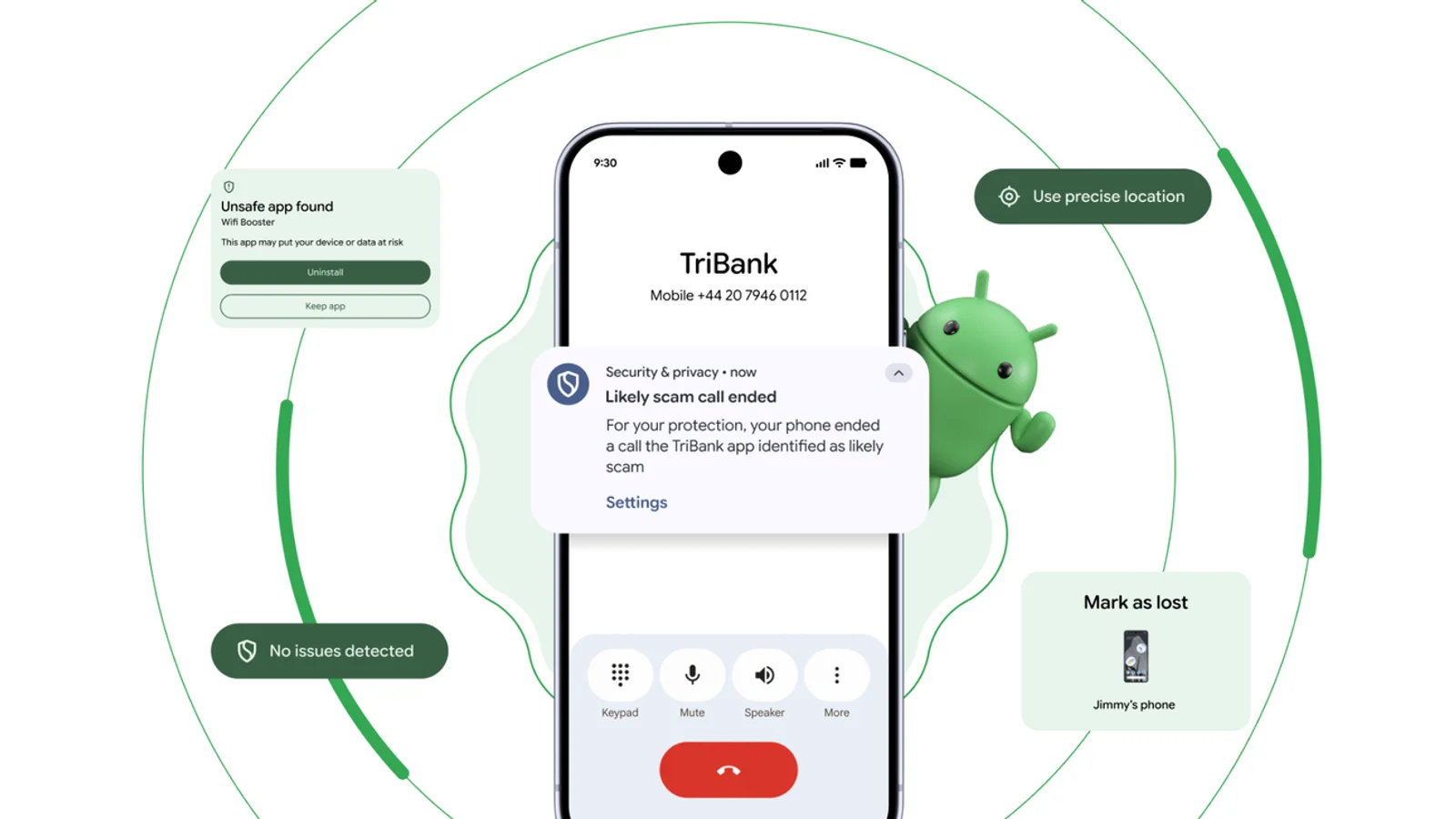
Google is rolling out a major security and privacy upgrade with Android 17, focusing on AI-driven threat detection, financial scam prevention, and stronger device protection. The update expands Android’s automated defenses against fraud, theft, and malicious apps while giving users more control over personal data.
The changes reflect a broader shift in mobile security, where operating systems rely on real-time AI monitoring and ecosystem-level verification instead of manual user intervention.
AI-powered protection against banking scams and spoofed calls
Android 17 introduces a verified financial call system designed to address banking scam calls, which remain a major source of financial fraud globally within the Google ecosystem.
The system includes automatic verification of incoming calls with participating banking apps, call termination if a bank confirms no legitimate call is being made, blocking of numbers flagged as “inbound-only” by financial institutions, and background authentication via installed banking apps.
Google said spoofed financial calls contribute to hundreds of millions of dollars in annual losses, making this one of the most targeted fraud vectors globally.
Live Threat Detection expands with real-time AI monitoring
Android 17 expands Live Threat Detection, a system that uses on-device AI to analyze app behavior in real time within the broader Google ecosystem.

The updated system now flags suspicious activity such as SMS forwarding without user awareness, hidden accessibility overlays used for deceptive actions, apps changing or hiding icons to avoid detection, and background activity linked to known malicious patterns.
Google is also introducing dynamic signal monitoring, allowing Android to update threat rules remotely as new attack methods emerge. This strengthens protection against evolving malware and scam tactics without requiring OS updates.
Stronger safeguards in Chrome and Advanced Protection mode
Security improvements also extend to browsing and system-wide protection tools within Android 17 under the broader Google ecosystem.
On Android Chrome, APK downloads are now scanned for known malware at download time, while Safe Browsing integration blocks suspicious apps before installation.
Meanwhile, Advanced Protection Mode receives additional hardening, including removal of accessibility service access for non-approved apps, disabling device-to-device unlocking in high-security mode, expanded scam detection in messaging notifications, and intrusion logging for forensic analysis in case of compromise.
Google is also extending Advanced Protection to enterprise environments, allowing organizations to enforce it across managed devices.
Theft protection becomes stricter and more automated
Android 17 introduces major upgrades to anti-theft systems within the broader Google ecosystem, building on previous lock and tracking features.
New protections include biometric authentication required to unlock devices marked as lost, restrictions on Quick Settings, Wi-Fi, and Bluetooth when “Mark as lost” is activated, reduced PIN/password guessing attempts with longer cooldowns, and expanded default theft protection in select global markets.
Additionally, IMEI access is now available directly from the lock screen on supported devices, helping recovery efforts without requiring full device access.
More granular privacy controls for location and contacts
Android 17 introduces new tools to reduce unnecessary data access from apps within the broader Google ecosystem.
Privacy updates include temporary location sharing only while an app is actively in use, real-time location indicators similar to camera and microphone alerts, a “recent app use” panel showing which apps accessed location data, and a contact picker system allowing apps to request specific contacts instead of full address books.
These changes aim to reduce long-term background tracking while preserving app functionality for tasks like navigation and communication.
AI security and OS verification upgrades
Android 17 expands AI and system-level trust mechanisms within the broader Google ecosystem.
Key developments include AISeal with pKVM for secure AI processing environments, enhanced Private Compute Core protections for sensitive data, Android OS verification to confirm official system builds, and a public cryptographic ledger for verifying Google app authenticity.
These tools aim to combat unofficial OS builds and strengthen trust in the Google ecosystem.
Toward a more automated security model
With Android 17, Google is moving further toward an automated security model powered by AI and system-level enforcement. Instead of relying solely on user decisions, Android increasingly handles fraud detection, app behavior analysis, and identity protection in the background.
The update reflects a broader industry trend where mobile security is becoming predictive rather than reactive, with AI systems continuously monitoring for threats across apps, networks, and device behavior.
Android 17 is expected to roll out later in 2026 across supported devices, with some features initially limited to Pixel hardware and select partners.