
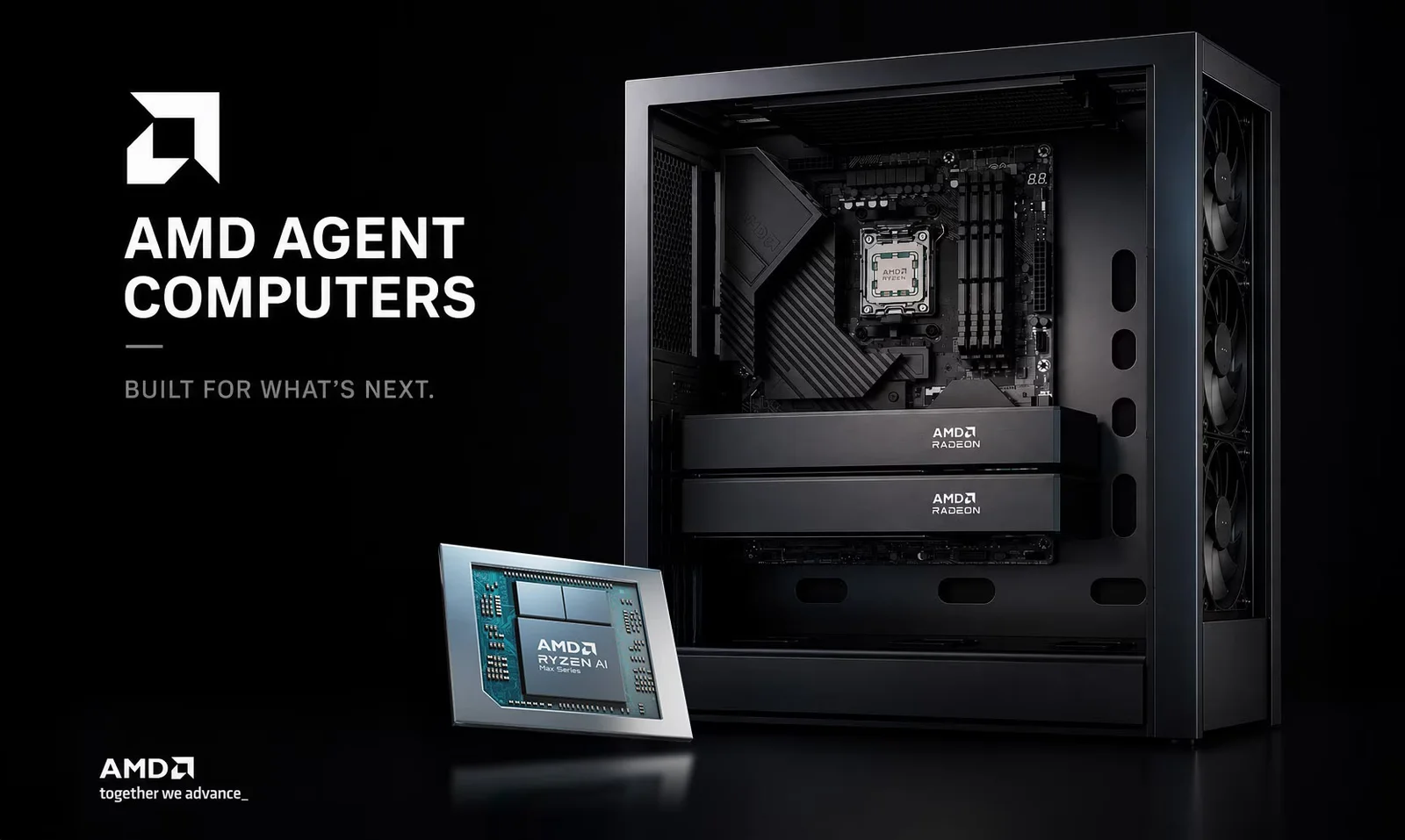
AI workloads are moving from occasional prompts to continuous processes, and AMD is positioning dedicated local systems as an alternative to paying for every AI task through the cloud.
The company is promoting the “Agent Computer,” a dedicated PC built to continuously run AI workloads for developers, creators and small teams. The concept combines AMD Ryzen AI Max processors, Radeon AI PRO graphics and the ROCm software stack to handle local AI inference, content generation and agent-based automation.
The pitch comes as AI agents increasingly perform multi-step tasks such as coding, research, document processing and workflow automation—workloads that can consume substantially more compute than a single chatbot interaction.
From AI prompts to continuous workloads
The first generation of generative AI largely revolved around individual prompts. Agentic AI changes that model by allowing systems to plan tasks, call tools, inspect results and iterate without requiring a new instruction at every step.
That can increase the amount of compute required by a single user or team.
AMD cited scenarios where an agent harness can consume more than a million tokens per day, particularly when used for coding, research, content production or business automation.

Instead of sending every step to a cloud model, AMD argues that users can divide workloads between local and cloud systems.
Local models can handle tasks such as drafting, summarization, code iteration, document processing and structured extraction, while larger cloud models can remain available for workloads that require more advanced reasoning or greater scale.
AMD highlights local AI economics
The company also used cloud API pricing to illustrate the potential economics of running AI locally.
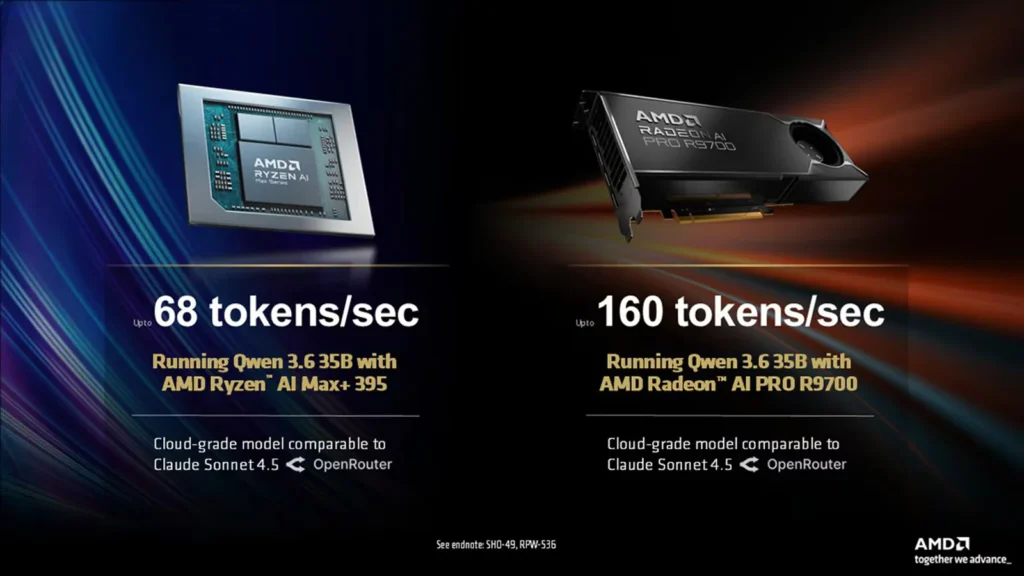
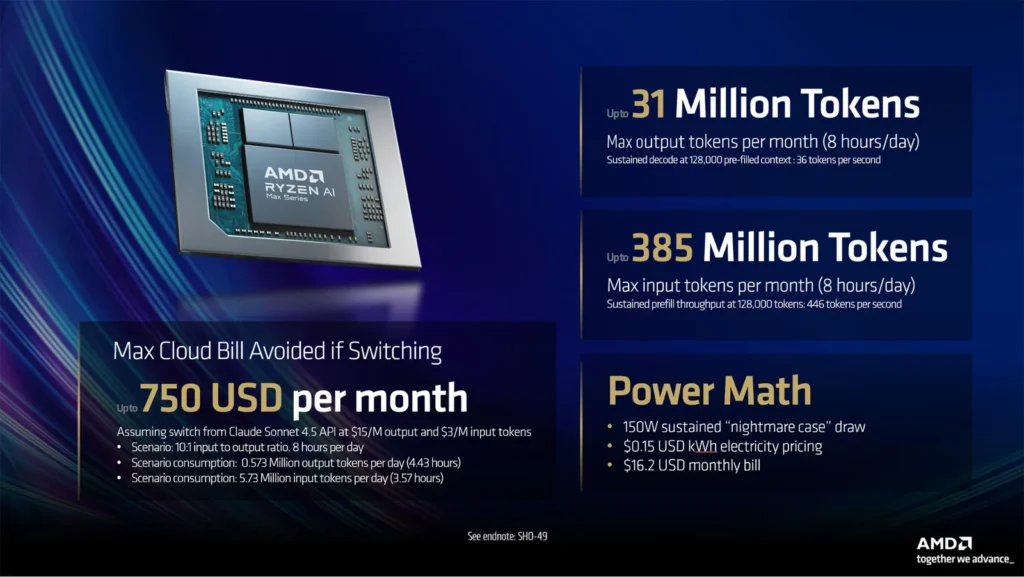
AMD compared local systems against Claude Sonnet 4.5 API pricing of $3 per million input tokens and $15 per million output tokens.
In one scenario, AMD said a Ryzen AI Halo-based system could process roughly 6 million tokens per day at sustained utilization, while electricity costs were modeled at around $16.20 per month.
Under the company’s assumptions, the system could avoid up to $750 per month in equivalent cloud API costs and reach break-even at around six months.
A higher-throughput configuration using a Radeon AI PRO R9700 was modeled at roughly 18 million tokens per day, with electricity costs estimated at $64.80 per month. AMD said that scenario could reach break-even at around three months.
These figures are based on AMD’s own workload and cost assumptions rather than a universal measure of local AI savings.
Actual economics depend on factors such as the model being used, context length, caching, batching, utilization, electricity prices and hardware configuration.
Local AI targets creators, too
AMD is also positioning Agent Computers as production machines for creators rather than purely developer-focused systems.
Local setups can run workflows through tools such as ComfyUI, allowing users to generate images, video, music and 3D assets without consuming cloud credits for every iteration.
AMD specifically highlighted video generation with LTX 2.3 and music generation through Ace Step 1.5 XL Turbo Text to Music.
These workflows allow creators to control parameters such as style, BPM, time signature, key, lyrics and vocals while keeping the generation process on local hardware.
The benefit, according to AMD, is less about replacing the creator and more about making experimentation cheaper and more accessible.
Creative work is inherently iterative, and local compute can allow users to generate, reject and refine more outputs without being limited by monthly cloud quotas or per-generation credits.
ROCm becomes critical to the local AI pitch
Hardware alone is not enough to make local AI practical.
Modern AI workloads depend on frameworks, drivers, libraries and applications working together, particularly for more demanding image, video, music and 3D generation tasks.
AMD is therefore positioning ROCm as a key part of its local AI strategy.
The software platform supports AI workloads built around frameworks such as PyTorch, with AMD citing applications including Stable Diffusion XL, Flux, Qwen Image, Hunyuan 3D, Ace Step, LTX and Wan among the workloads that can run on its hardware.
That software layer is important for AMD’s broader argument: an Agent Computer needs to function as a complete AI platform rather than simply a powerful PC with an AI-capable processor or GPU.
The cloud remains part of the equation
AMD’s proposal is not to eliminate cloud AI.
Instead, the company sees local and cloud computing working together.
Cloud infrastructure remains useful for the largest models, centralized services and workloads that require elastic scaling. Local hardware, meanwhile, can handle high-volume or repetitive workloads where latency, privacy, control and predictable operating costs matter.
That creates a hybrid model in which users choose where individual AI tasks should run.
For developers, that could mean running coding agents locally while accessing larger cloud models for complex reasoning. Creators could generate assets locally while using cloud services for workloads that exceed their hardware’s capabilities.
For small businesses, repetitive internal AI workflows could potentially run on dedicated hardware without generating a separate API charge for every execution.
Agent Computers target the next PC workload
The broader argument behind AMD’s Agent Computer concept is that AI agents could become another major PC workload category.
Traditional PCs evolved around productivity software, while gaming PCs grew around graphics workloads and workstations became increasingly focused on professional content creation.
AMD now sees continuous AI execution—and particularly agentic AI—as another workload capable of shaping the next generation of personal computing.
The company’s Ryzen AI Max processors, Radeon AI PRO graphics and ROCm platform are positioned as the hardware and software foundation for that shift.
Rather than treating AI as something users access exclusively through a browser or cloud subscription, the Agent Computer concept puts dedicated AI compute back on the user’s desk.