
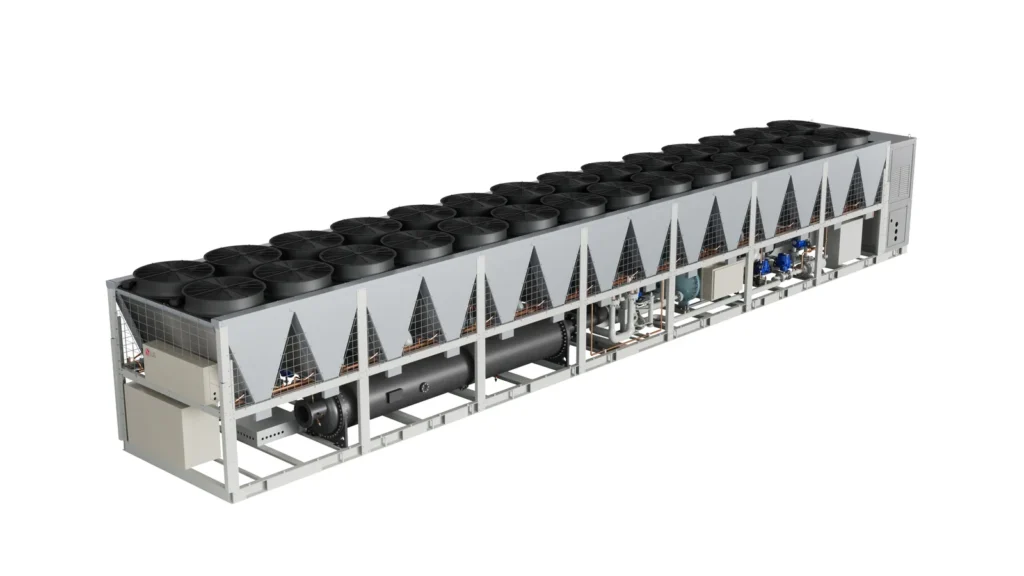
As AI infrastructure expands in the Philippines, LG Electronics is targeting the growing demand for data-center cooling with a new Air-Cooled Centrifugal Chiller designed for high-density computing environments.
LG’s new chiller combines an oil-free magnetic bearing compressor, refrigerant free-cooling technology and data-center management software to address both energy consumption and cooling continuity.
The system offers cooling capacities ranging from 480 to 600 refrigeration tons (RT) per unit, allowing it to be configured for different data-center requirements.
AI data centers put more pressure on cooling
The growth of cloud computing, digital services and data-sovereignty requirements is driving expansion in the Philippine data-center market, according to the U.S. International Trade Administration.
As AI workloads become more computationally demanding, data centers also need to manage the heat generated by increasingly dense computing infrastructure.
LG’s new chiller is designed around that requirement, with technologies intended to reduce cooling energy consumption while maintaining operation during power disruptions.

Oil-free compressor cuts mechanical losses
At the heart of the Air-Cooled Centrifugal Chiller is an oil-free magnetic bearing centrifugal compressor.
The system uses magnetic force to suspend the rotating shaft rather than relying on physical contact. LG says this eliminates the need for lubricating oil and reduces mechanical friction losses.
The chiller also uses refrigerant free-cooling, which takes advantage of cool outdoor air to reduce the workload placed on the compressor.
Rather than using an intermediate heat exchanger, the system circulates refrigerant directly and does not require glycol. LG says this can reduce heat and pressure losses while simplifying maintenance.
Based on LG’s internal simulation, refrigerant free-cooling can use approximately 30% less energy annually than waterside free-cooling.
The company’s Series Counter Flow (SCF) technology is also designed to distribute cooling loads across the compressors for more balanced operation.
LG promises faster recovery after outages
Cooling continuity is particularly important for data centers, where prolonged temperature increases can affect computing equipment.
LG’s chiller uses a gap sensor in its magnetic bearing system to detect the rotation axis and control it precisely. Machine-learning capabilities are also used to adapt the system to operating patterns and help reduce surges.
During a power outage, an integrated uninterruptible power supply (UPS) provides emergency power so the compressor shaft can stop safely.
When power returns, LG says the system can restore full cooling capacity within three minutes.
Software monitors the entire cooling system
LG is pairing the chiller with its Data Center Cooling Management (DCCM) software, which provides centralized monitoring and data-driven control across multiple cooling components.
The platform can monitor Coolant Distribution Units (CDUs), Computer Room Air Handlers (CRAHs), and air-cooled centrifugal chillers, giving operators a centralized view of their cooling infrastructure.
DCCM also supports early anomaly detection and virtual sensor-based diagnostics. LG says these capabilities can support predictive maintenance while optimizing cooling based on IT workloads.
This approach allows operators to manage cooling infrastructure as a connected system rather than treating individual chillers and other cooling components separately.
LG builds its own chiller components
LG says its Core Tech covers key components including compressors, motors, inverters and magnetic bearings.
The company develops and manufactures these components internally before integrating them into complete cooling systems. According to LG, this approach helps with system optimization, parts availability and maintenance response.
LG also says its chillers and testing facilities are certified under standards established by the Air-Conditioning, Heating, and Refrigeration Institute (AHRI), while its air-cooled chillers have received the AHRI Performance Award for nine consecutive years.
The company’s chillers also meet various international requirements, including ASME, ETL and CE standards.
LG showcases modular cooling for expanding AI infrastructure
LG is also expanding its data-center portfolio beyond the new centrifugal chiller.
At Data Centre World Asia 2026 in Singapore from September 29 to 30, the company is showcasing a modular hydronic cooling solution that combines chilled-water pumps with a Thermal Energy Storage buffer tank.
The prefabricated system is designed to simplify installation and support faster deployment as AI data centers increase their capacity.
“As AI data centers become increasingly dense and heat-intensive, energy-efficient, reliable cooling is more critical than ever,” said James Lee, president of the LG ES Company.
“With our Core Tech and data center cooling expertise, we will continue to expand our portfolio of solutions to meet these evolving requirements.”