
The Philippines’ digital economy is on track to reach $42 billion in gross merchandise value (GMV) by the end of 2026, according to the 11th annual e-Conomy SEA report released by Google, Temasek, and Bain & Company. The figure represents 15 percent year-on-year growth from $36 billion in 2025. The report also projects that the country’s digital economy could reach as high as $157 billion by 2035.
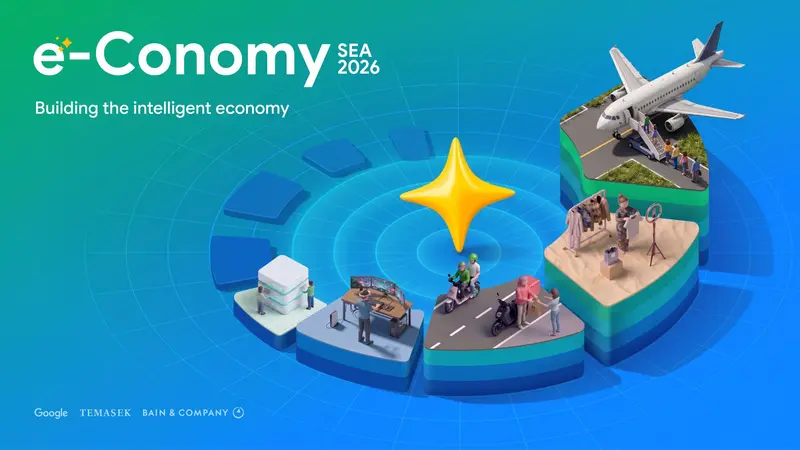
Titled Building the Intelligent Economy, the report says the Philippines’ digital economy is continuing to accelerate, increasingly helped by AI adoption and usage as a growth lever. It identifies policy support, evolving Filipino user behavior, and digital payments as factors in the long-term outlook for AI and the digital industry. The report was released in Manila on November 3, 2026.
AI adoption reaches mass-market scale
To measure adoption, the report introduces AI usage, quantified in tokens, as the AI equivalent of GMV. It says 53 percent of the working population in the Philippines actively uses standalone GenAI platforms, while the country has substantial headroom for future user and enterprise growth.
The report says 42 million Filipinos use GenAI and generate 55 billion annual AI queries. Around 65 million monthly AI users are counted when embedded AI use is included. One in four AI users in the Philippines interacts with AI tools every day, while one in two users trusts AI more than in the previous year. Seven out of 10 users are willing to delegate purchase decisions to the insight of AI.
Although 33 percent of consumer journeys in the Philippines begin with AI, users average around 1.87 AI sessions per week and 13 million consumer tokens per GenAI user. Most Filipinos prefer conversing with AI in English, while local-language prompts account for 21 percent of conversations. Gemini prompts for customer support content are nearly three times the regional average.

The top five reported AI uses are study, work, health, online shopping, and entertainment. Consumer applications account for around 80 percent of AI usage in the Philippines. Bain & Company Partner Bennett Aquino said the next chapter involves turning occasional AI use into everyday workflows that benefit Filipino individuals and businesses. He also cited the National AI Center for Research and Innovation rolling out in 2026 and National Privacy Commission frameworks supporting responsible adoption.
Philippines digital economy growth across online sectors and payments
The report says GMV growth is mainly driven by ecommerce, online travel, and online media. Ecommerce grew 15 percent year-on-year to $28 billion in 2026. Online travel grew 14 percent to $3 billion, compared with 9 percent in the previous year, while online media grew 26 percent to $6 billion, compared with 23 percent in the previous year.
Mobility and food grew two percent year-on-year to $4 billion and are projected to reach $7 billion by 2030 and $11 billion by 2035. Digital payments grew 23 percent year-on-year in 2026 to $194 billion in gross transaction value, the fastest growth in Southeast Asia. The report says this was supported by national digital ID scaling, InstaPay for Business, and the merger of BancNet and the Philippine Clearing House Corporation to streamline payment interoperability.
Digital lending reached a $7 billion loan book balance, up 17 percent year-on-year from $6 billion in 2025, and is projected to reach $31 billion by 2035. Digital insurance reached $110 million in annual premium equivalent and gross written premiums, up 16 percent year-on-year and tying with Vietnam for Southeast Asia’s fastest-growing digital insurance sector.
These figures define the report’s view of Philippines digital economy growth across AI, online sectors, digital payments, and other digital financial services. Its long-term projection for Philippines digital economy growth reaches as high as $157 billion by 2035.