
# Philippine AI Maturity Report finds execution gap
Philippine companies have ambitious AI targets, but a BCG and Makati Business Club (MBC) study says those ambitions have not yet translated into sustained business outcomes. Released on November 11, 2026, The Philippine AI Maturity Report surveyed 35 large Philippine companies across 12 industries.
The study places the Philippines’ average AI maturity in 2026 roughly two years behind the global AI maturity curve, according to BCG and MBC. It uses BCG’s Applied AI Index framework, which assesses maturity across eight capability areas and 41 dimensions, along with deployment across 14 business workflows and investment levels.
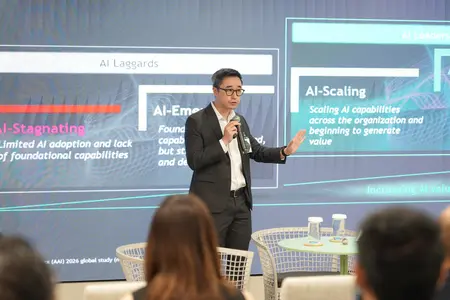
The framework groups organizations into four stages: Stagnating, Emerging, Scaling, and Future-built. BCG and MBC said 60% of surveyed organizations are currently Stagnating or Emerging, while none has reached Future-built status. Yet 54% of respondents target Future-built maturity by 2029.
Foundations are ahead of outcomes
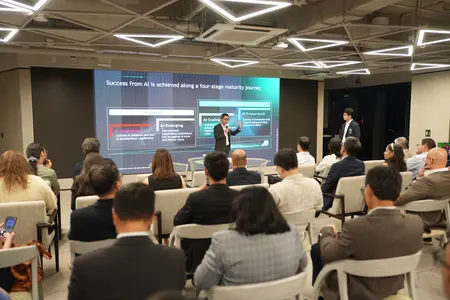
The Philippine AI Maturity Report found a gap between AI foundations and business outcomes. The four enabling capabilities—Technology, Data, People, and Operating Model—recorded an average score of 46. That compares with 37 across the business-outcome areas of Innovation, Customer Experience, and Operations.
Customer-facing use cases were among the weaker outcome areas, according to the study. It cited agentic AI innovation, AI-powered pricing, marketing and personalization, and customer journey as relatively immature capabilities.

Julian Cua, BCG Managing Director and Partner in Manila and a report co-author, said: “Philippine business leaders are recognizing the potential of AI, as seen through their ambitious AI targets. The gap is in turning this ambition into real business value,” said Julian Cua, Managing Director and Partner at BCG Manila, and one of the co-authors of the report. “The critical question is no longer whether AI is coming, but what companies choose to do with it now that it is here.”
What separates higher-maturity companies
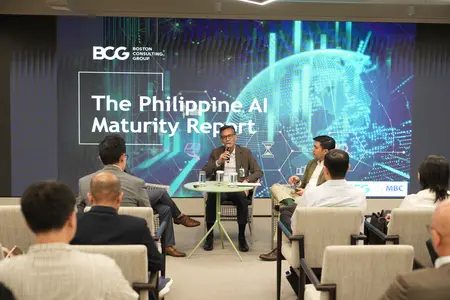
The report said the top 10 Philippine companies outperformed the bottom 10 across every capability area. The widest differences were in operating model, at 46 points; people, at 40 points; and technology, at 38 points.
It also reported broader live AI deployment among higher-maturity organizations. In IT and data workflows, 80% of the top companies reported live AI deployments, compared with 20% of the bottom 10. Higher-maturity companies dedicated 13.4% of IT budgets to AI, compared with 7.7% for lower-maturity companies.
The Philippine AI Maturity Report said foundational IT spending represented 3.1% of revenue, compared with 2.6% globally and 3.7% in Southeast Asia. BCG and MBC said this suggests the difference lies in how companies organize and invest around AI, rather than technology spending alone.
The study identified three connected constraints: data, talent, and cost. It said 74% of Philippine enterprises have migrated all or most of their IT infrastructure to the cloud, but 49% still cite legacy systems as a major barrier to digital transformation. AI-skill job postings rose more than sixfold between 2021 and 2025, while only 17% of organizations said they can recruit and retain enough AI-skilled talent.
The report sets out six imperatives for companies, including a multiyear AI agenda tied to business outcomes, people upskilling, continued technology and data investment, and mechanisms to track AI impact while allowing experimentation. The full report is available from BCG.