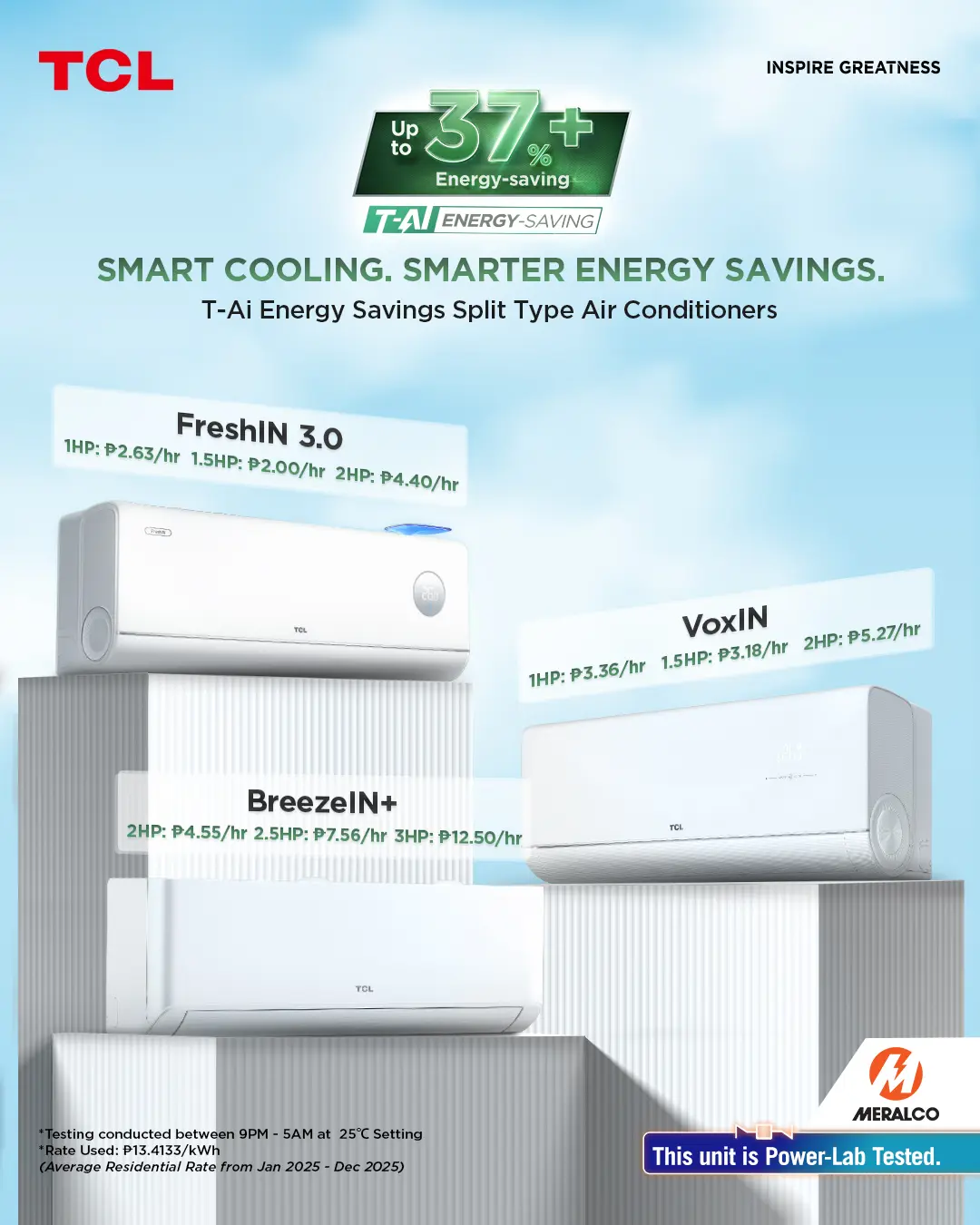
TCL Philippines is highlighting its air conditioner lineup as an option for households managing indoor humidity and electricity costs during the rainy season. The company says its T-AI Energy Saving technology can reduce energy consumption by up to 37%+, while costs and performance vary according to usage, environmental conditions, appliance condition, and electricity rates.
The announcement centers on TCL air conditioner energy savings through the company’s T-AI system, which TCL says reads room conditions to optimize cooling and reduce wasted power. The technology is included across the FreshIN 3.0, VoxIN, and BreezeIN+ residential air-conditioning lines.
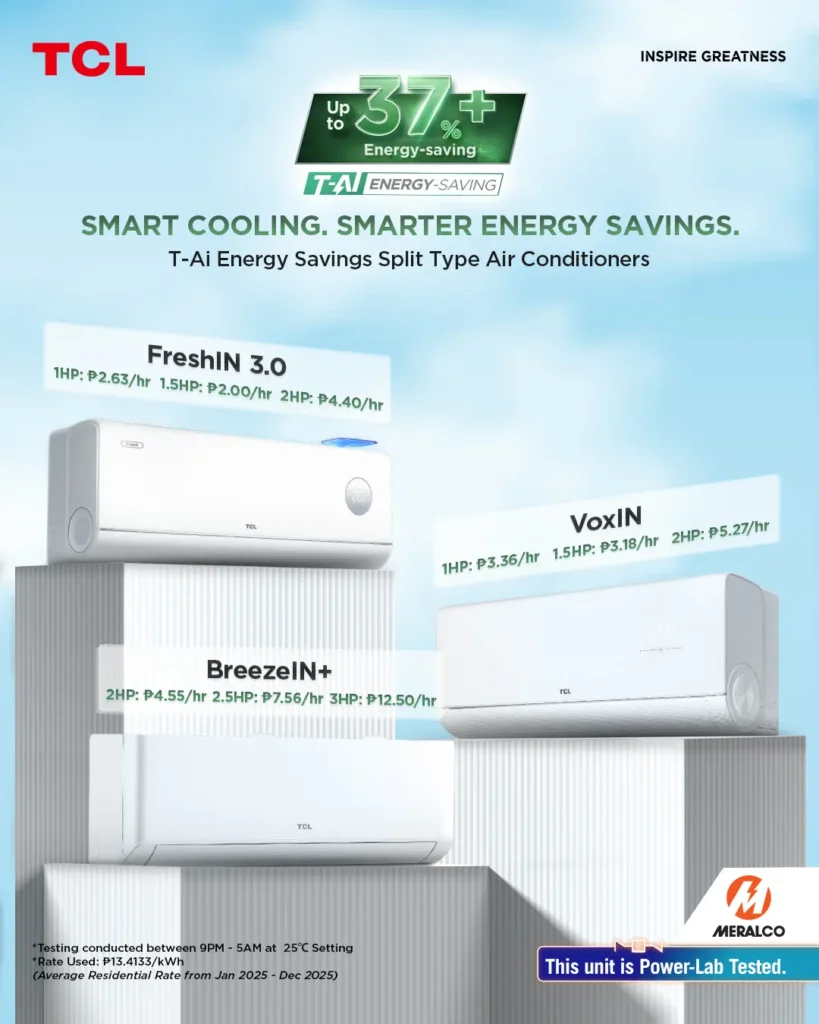
Lineup and operating-cost claims
TCL says the FreshIN 3.0 has an A+++ energy rating and an upgraded T-AI algorithm. The company identifies the 1.5HP model as having an estimated operating cost as low as ₱2.00 per hour of use.
The VoxIN is described as a voice-controlled air conditioner that combines T-AI energy-saving technology with TCL’s Gentle Breeze feature. According to the company, the feature disperses cool air softly rather than directing a concentrated stream of air at occupants. TCL lists the VoxIN 1.5HP variant at an estimated cost as low as ₱3.18 per hour of use and identifies it as having an A+++ energy rating.
The BreezeIN+ Series is designed for operation in demanding heat conditions. TCL says its Air-cooled E-box supports consistent cooling when outdoor temperatures reach 60°C. The company lists the BreezeIN 2HP model at an estimated operating cost as low as ₱4.55 per hour.
These figures are estimates based on tests conducted by the Meralco Power Lab. The source notes that higher ambient temperatures can increase running costs because an air conditioner may need to work harder and operate longer to maintain a cool room. The lab context is important when considering air conditioner energy savings alongside the listed hourly estimates.
Meralco Power Lab certification
TCL says its latest air-conditioning units were tested and certified by the Meralco Power Lab. The facility is described as an educational and testing center that demonstrates electricity-consumption patterns and helps consumers understand appliance energy efficiency.
The lab’s testing and demonstration areas use controlled conditions, but the facility states that actual energy consumption, running costs, and technology performance may differ in real-world use. Results can be affected by usage habits, appliance condition, environmental factors, and prevailing electricity rates. The source also notes that test outputs do not constitute an official Meralco product endorsement or a lifetime performance guarantee.
For households evaluating TCL air conditioner energy savings, the company’s published figures should therefore be read alongside the laboratory’s conditions and limitations. TCL Philippines Chief Executive Officer Peter Chen said the company wants home comfort to be less of a financial burden. TCL Philippines Business Development Manager of Air Conditioner Randy Benito A. Raguero said the certification supports the company’s energy-saving claims.
TCL Philippines directs consumers to its air-conditioner website at https://www.tcl.com/ph/en/air-conditioners/tcl-ac for more information. The company’s listed residential models, cost estimates, and certification claims are presented as part of its current product information. No additional rollout date or promotional period was provided in the source.