
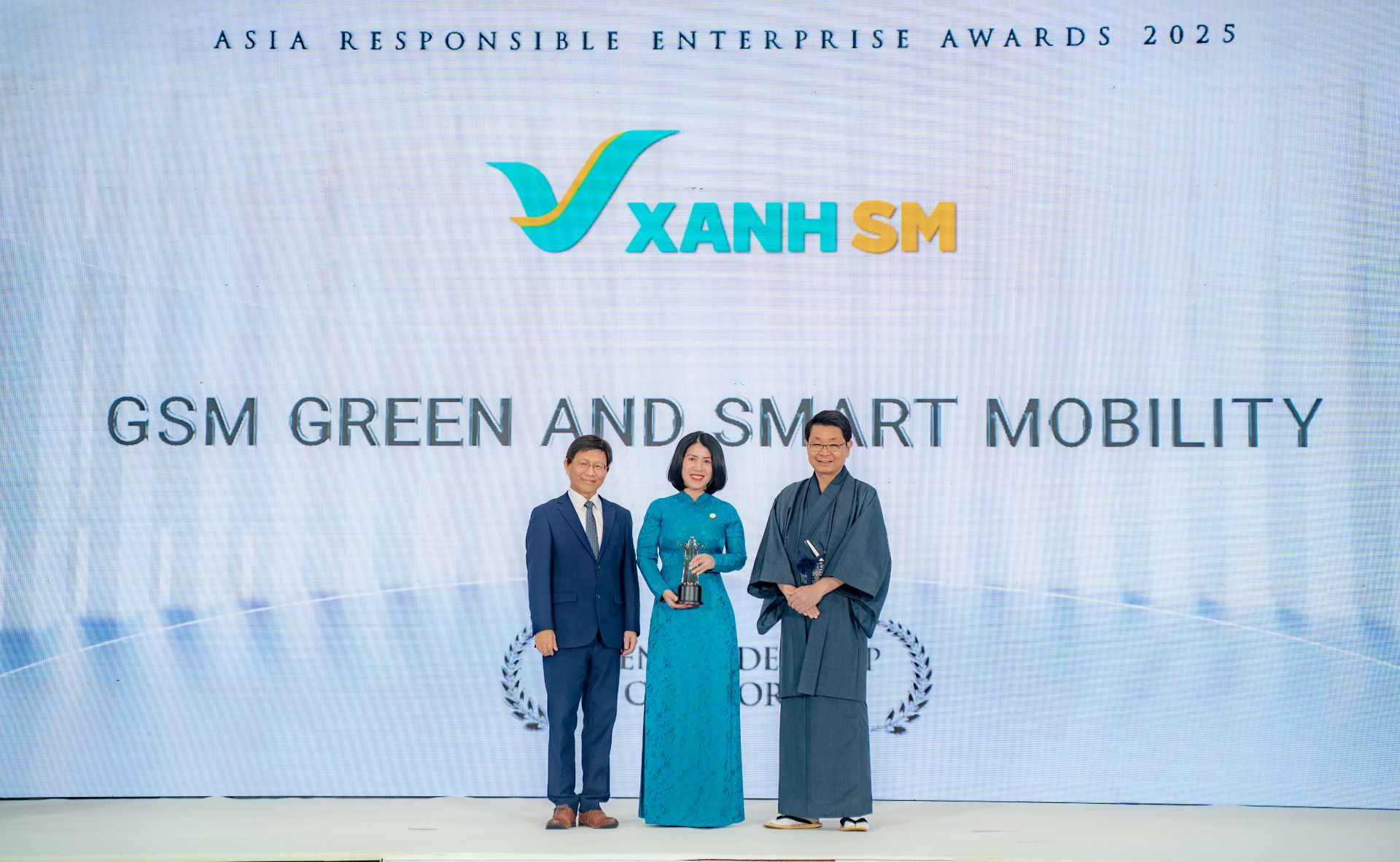
Green GSM’s Electric Fleet Crowned Green Leadership At AREA
AREA 2025 Spotlight on Responsible Enterprise
At the Asia Responsible Enterprise Awards (AREA) 2025 in Bangkok, Green GSM clinched the Green Leadership accolade. AREA, founded by Enterprise Asia in 2011, honors excellence in sustainability and social responsibility. This year’s theme—“A Necessary Shift to a Regenerative Economy”—called on businesses to restore ecosystems and deliver community value. Against that backdrop, Green GSM’s recognition is more than a trophy. It’s a nod to a ride-hailing platform that’s rewriting the rules for urban transport across Southeast Asia.
An All-Electric Ride-Hailing Ecosystem
Green GSM isn’t just another app. It’s Southeast Asia’s first all-electric ride-hailing platform, built on Vietnam’s Green and Smart Mobility Joint Stock Company (GSM). At its core lies an in-house fleet of electric vehicles. But that’s only half the story. A second pillar is the Xanh SM Platform, which invites VinFast EV owners to join the network. Then there’s the third leg: partnerships with legacy taxi operators ready to electrify. Together, these components form a flexible ecosystem—bridging company-owned assets, private EV drivers, and traditional cabs in transition.
Xanh SM Platform: Power to Individual EV Owners
Where conventional ride apps grind their gears, Green GSM’s Xanh SM Platform revs up with inclusion. Individual VinFast owners register, undergo training, and unlock booking algorithms. The platform manages dispatch, billing, and driver ratings. Riders get the same seamless booking experience—just in a zero-emission vehicle. For drivers, this means tapping into a green network without costly fleet investments. It’s a democratizing move that scales capacity quickly while sustaining Green GSM’s environmental ethos.
Traditional Taxi Operators Join the Charge
Electrification isn’t confined to startups. Green GSM reached out to established names like G7, Mai Linh, Lado, and En Vang in Vietnam. These taxi firms needed EV expertise—to source vehicles, install chargers, and train staff. Green GSM’s technology platform, plus its “roadshow-to-fleet” consulting, smoothed the transition. Today, 19 transport companies boast fully electric fleets under their own brands, accounting for nearly 40 percent of Vietnam’s e-taxi market. Suddenly, going green isn’t optional. It’s a competitive edge.

Embedding Sustainability in Culture
“Sustainability at Green GSM goes beyond strategy,” said Phan Thi Hong Dung, Director of Training and Culture Development at GSM. “It is woven into every decision, every ride, every interaction.” At the AREA awards, she emphasized that individual riders and drivers must “live green, work green, and serve with kindness.” From training modules on efficient driving to in-app nudges that encourage shared rides, Green GSM turns each trip into a micro-lesson in environmental stewardship.
Quantifying Impact: Trips, Kilometers, and Carbon
Numbers don’t lie: in just two years, Green GSM completed over 300 million trips, covering 1.7 billion zero-emission kilometers—enough to circle Earth 42 times. The total CO₂ reduction exceeds 211,000 tons, roughly the carbon absorption of 3,200 hectares of forest. These aren’t abstract benchmarks. They translate to clearer skies in Ho Chi Minh City, less noise pollution in Jakarta, and lower urban smog in Manila. It’s proof that ride-hailing can be both scalable and sustainable.
Leading the Charge in Vietnam
On home turf, Green GSM claims nearly 40 percent market share in the electric taxi segment. Competing against gasoline giants, it emerged by marrying technology—real-time dispatch, dynamic pricing, and data-driven route optimization—with a relentless focus on user experience. Smartphone apps feature live EV range metrics, charging-station locators, and eco-score leaderboards that gamify efficient driving habits. The result? Electric ride-hailing went from novelty to norm in under a year.
Regional Expansion: From Laos to Philippines
Green GSM’s success in Vietnam kicked open doors in Laos, Indonesia, and the Philippines. Each market presented unique challenges—regulatory hurdles, patchy charger networks, or local EV adoption rates. Yet Green GSM’s modular model scaled seamlessly. Local VinFast partners supplied EVs in Laos. Indonesia’s gig economy welcomed app-based onboarding. In the Philippines, local authorities fast-tracked charger permits, letting Green GSM go public in Metro Manila on June 10, 2025.
Navigating Market Diversity
Operating across four countries taught Green GSM agility. A single app adapts to local languages, fare structures, and payment systems—GCash in Manila, QR codes in Jakarta, bank transfers in Hanoi. Regulatory compliance modules automate digital permits and driver background checks. And in markets with nascent EV adoption, Green GSM co-invests in fast chargers at transit hubs. This localization playbook positions the brand for future entries across Asia.
Go Green Global: Vision for a Regenerative Economy
Green GSM’s AREA award isn’t a finish line. It’s a milestone on a broader “Go Green Global” mission. By integrating fleet operations, platform technology, and partnership networks, the company projects a blueprint for regenerative urban mobility. Each EV ride becomes a data point for smarter grid integration and renewable energy scheduling. In essence, Green GSM seeds a future where transportation restores, not depletes, ecosystems.
Public Launch in Metro Manila
On June 10, 2025, Metro Manila witnessed Green GSM’s formal public launch. Jeepney and taxi drivers sat alongside tech execs to demo the app’s features. Flag-off ceremonies drew local mayors who praised the company’s potential to cut Manila’s infamous gridlock emissions. Riders in Pasig and Makati scored free trial rides funded by incentives. Their feedback—more quiet cabins, smoother acceleration—spoke volumes: sustainable mobility sells itself when friction vanishes.
Partnerships Fueling Tomorrow’s Mobility
Looking ahead, Green GSM eyes further collaborations: solar-canopied charging stations with utilities, microgrid pilots with clean-energy startups, and city-level data-sharing agreements for traffic decongestion. Each tie-up extends the regenerative economy narrative—from single-rider trips to holistic smart-city ecosystems.