
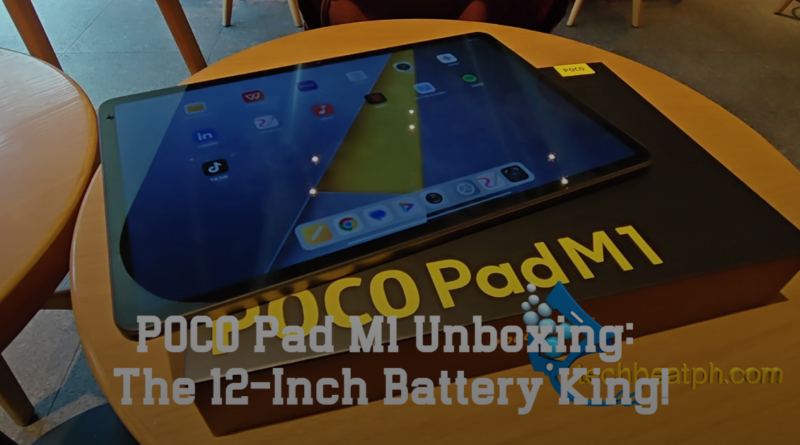
POCO Pad M1: A 12-Inch Canvas for the Mobile Generation
POCO Pad M1: A 12-Inch Canvas for the Mobile Generation
Redefining the Android Tablet Experience
When the POCO Pad M1 landed on my desk, my first instinct was skepticism. The Android tablet market has long been a wasteland of oversized phones or overpriced laptop wannabes. We have seen countless iterations of “entertainment tablets” that stutter through basic tasks and “productivity slates” that cost more than a decent Ultrabook. However, as I sliced through the plastic wrap of the POCO Pad M1, something felt different. This wasn’t just another slate; it felt like a statement of intent. POCO Pad M1: A 12-Inch Canvas for the Mobile Generation
POCO has built its reputation on disrupting the smartphone market by offering flagship performance at mid-range prices. With the Pad M1, they are attempting to apply that same philosophy to the tablet space. The target audience is clear: Gen Z students, young professionals, and mobile gamers who demand performance but refuse to pay the premium tax. It’s a device that screams “Play to the Max,” and after spending some time with it, I’m starting to think they might just pull it off.
The Visual Feast: 12.1-Inches of 120Hz Glory
The centerpiece of any tablet is the display, and POCO has not cut corners here. The Pad M1 boasts a massive 12.1-inch LCD panel with a sharp 2.5K resolution (2560 x 1600). This translates to a pixel density of 249 ppi, which is perfectly adequate for a screen you typically hold at arm’s length. But the real star of the show is the 120Hz refresh rate.
In 2025, a 60Hz screen on a device meant for media consumption feels archaic. The 120Hz panel on the Pad M1 makes everything feel fluid and responsive. Whether you are scrolling through a 50-page PDF for class or tracking an enemy in Call of Duty Mobile, the high refresh rate provides a tangible advantage. The display also supports Dolby Vision, ensuring that Netflix binges are delivered with punchy colors and decent contrast, despite the lack of an OLED panel. With a peak brightness of 600 nits, it’s legible indoors, though direct sunlight remains its kryptonite. POCO also included the requisite TÜV Rheinland certifications for Low Blue Light and Flicker-Free viewing, a thoughtful addition for students pulling all-nighters. POCO Pad M1: A 12-Inch Canvas for the Mobile Generation
Power and Performance: The Snapdragon Surprise
Under the hood lies the Snapdragon 7s Gen 4 Mobile Platform. This 4nm chipset is a significant step up from the aging processors often found in budget tablets. It’s an octa-core beast clocking up to 2.7GHz, designed to handle multitasking and gaming with ease. During my initial testing, the tablet breezed through UI navigation and app switching. The AnTuTu benchmark score of over 1 million points puts it squarely in the upper-mid-range category, capable of running demanding games like Genshin Impact at respectable settings.
Paired with 8GB of RAM and 256GB of storage, the Pad M1 offers plenty of headroom for most users. But the real kicker is the expandable storage. The ability to add up to 2TB via a microSD card is a feature that is vanishing from premium devices, yet remains essential for users who want to carry their entire media library offline. It’s a nod to the practical needs of the target demographic—users who consume massive amounts of content and don’t want to rely solely on the cloud.
The Endurance Champion: 12,000mAh Battery
If the display is the face of the operation, the battery is its tireless heart. The POCO Pad M1 packs a colossal 12,000mAh battery. To put that in perspective, most flagship tablets hover around the 8,000 to 10,000mAh mark. This extra capacity translates to real-world endurance that is genuinely impressive. POCO claims over 83 days of standby time and 105 hours of music playback.
While I haven’t had 83 days to test the standby claim, my usage suggests that this tablet can easily last two to three days of moderate use on a single charge. The inclusion of 33W fast charging is decent, though filling up a 12,000mAh tank still takes time. However, a unique feature that caught my eye is the 27W wired reverse charging. This essentially turns the tablet into a massive power bank, allowing you to charge your phone or earbuds in a pinch. It’s a practical, thoughtful addition that adds significant utility to the device.
HyperOS and Connectivity: Building an Ecosystem
The Pad M1 runs on Xiaomi HyperOS, which brings a suite of interconnectivity features designed to bridge the gap between your phone and tablet. Features like Home screen+ 2.0, shared clipboard, and network sync allow for a seamless workflow if you are already in the Xiaomi ecosystem. The ability to use your phone as a webcam or share mobile data with a single tap makes the tablet feel less like an island and more like an extension of your digital life.
The software experience feels optimized for the larger screen, with better multitasking windows and app scaling than stock Android. Support for the POCO Smart Pen and Keyboard (sold separately) transforms the device from a consumption slab into a legitimate productivity tool. The pen offers low latency and pressure sensitivity, making it viable for note-taking and sketching, while the keyboard adds PC-like typing capability.
Fluffy’s Take: The “Good Enough” Sweet Spot
As the Editor-in-Chief of TechBeatPh, I’ve reviewed devices that cost five times as much as the POCO Pad M1, and often, they leave me feeling cold. They offer power I don’t need and features I’ll never use. The POCO Pad M1, on the other hand, hits a sweet spot that is hard to ignore.
It isn’t perfect. The charging could be faster, the cameras are purely functional, and an OLED screen would have been the cherry on top. But for the price, the value proposition is undeniable. This is a tablet that understands its audience. It knows you want a big screen for Netflix, a fast processor for gaming, and a battery that won’t die during a long commute. It delivers on those core pillars with confidence.
For the student who needs a digital notebook, the young professional who wants a secondary screen, or the gamer who wants a larger canvas, the POCO Pad M1 is a compelling choice. It brings the “Play to the Max” ethos to a form factor that desperately needed a shake-up. It’s not just a big phone; it’s a surprisingly capable computer that fits in your backpack. And in a world of expensive compromises, that is a refreshing change of pace.
