

OPPO Redefines Mobile AI With Snapdragon 8 Elite
OPPO Redefines Mobile AI With Snapdragon 8 Elite
Speed That Rivals the Cloud
At the Snapdragon Summit 2025 in Beijing, OPPO showed off something that felt less like an incremental update and more like a leap forward. Running on Qualcomm’s Snapdragon 8 Elite Gen 5 Mobile Platform, OPPO demonstrated on-device AI inference speeds surpassing 200 tokens per second. That’s not just fast—it’s the fastest announced on-device performance in the industry so far. OPPO Redefines Mobile AI With Snapdragon 8 Elite
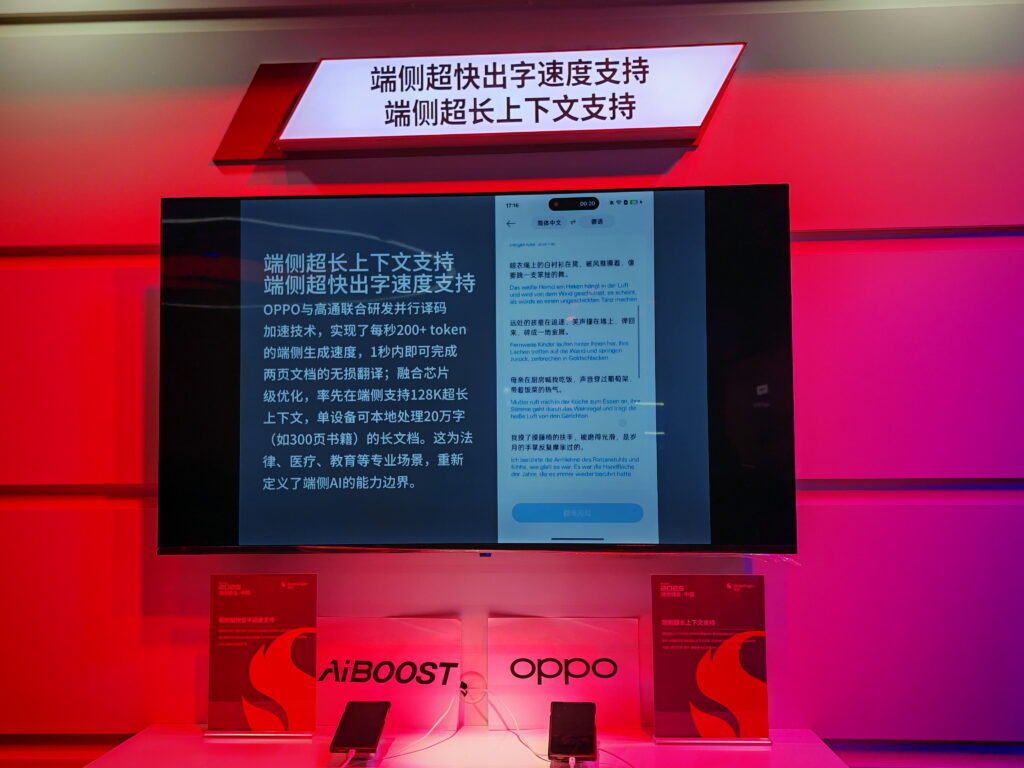
To put that into perspective, the system can generate a full page of text in under two seconds. Imagine real-time translation of multi-paragraph conversations or instant content creation without waiting for a server to respond. Latency is so low it rivals cloud-based services, but the kicker is that it all happens locally on your device.

This is made possible by a parallel decoding architecture and deep optimization of the Snapdragon 8 Elite Gen 5. The result is an 8x improvement in decoding acceleration compared to the previous generation. For readers, this means your phone could soon handle tasks like AI writing, translation, or summarization as smoothly as streaming a video.
I’ve seen plenty of AI demos that look good on stage but stumble in real life. This one feels different. It’s fast, it’s efficient, and it’s practical.
Context Handling That Reads Like a Human
Speed is one thing. Context is another. OPPO also unveiled its long-context acceleration technology, which allows devices to handle up to 128K tokens. That’s roughly 200,000 words or about 300 pages of text—all processed entirely on-device.
Think about what that means. Legal professionals could analyze entire contracts without sending sensitive data to the cloud. Doctors could review extensive medical records offline. Students could load entire textbooks into their device and query them in real time.
For readers, this is a huge win for privacy and productivity. You’re not just getting faster AI—you’re getting smarter AI that can handle the scale of real-world information without compromising security.
As someone who spends hours reviewing long reports, I can’t help but imagine how much time this could save. It’s like having a research assistant who never gets tired and never leaks your data.
Hybrid AI: The Best of Both Worlds
OPPO isn’t betting everything on on-device AI alone. Instead, it’s pursuing a hybrid strategy that combines the efficiency and privacy of local processing with the scalability of the cloud.
On-device AI handles tasks that require speed, security, and offline reliability. Cloud AI steps in when massive compute power or broader data access is needed. By synchronizing these improvements with OS updates, OPPO ensures that devices keep getting smarter over time.
For readers, this means you don’t have to choose between privacy and performance. You get both. And as AI models grow larger and more complex, this hybrid approach ensures your device won’t be left behind.
Personalized AI That Knows You Better
Beyond raw performance, OPPO is laying the groundwork for what it calls “agentic AI.” This is AI that doesn’t just respond to commands—it anticipates needs. By introducing a user-knowledge system, OPPO aims to reduce information fragmentation. In plain English, your device will remember context across apps and interactions, making your digital life feel more seamless.
Privacy is protected through OPPO’s Private Computing Cloud (PCC), which ensures sensitive data stays secure. Combined with Qualcomm’s hardware-level security, this creates a foundation for deeply personalized yet safe AI experiences.
For readers, this means your phone could soon act less like a tool and more like a partner. Imagine an assistant that not only translates your emails but also understands which ones are urgent, or one that doesn’t just track your schedule but suggests when to take a break.
I’ve always believed that personalization is the holy grail of AI. Done right, it makes technology invisible—working in the background to make life easier. Done wrong, it feels creepy. OPPO seems to be leaning toward the former, and that’s encouraging.
Snapdragon 8 Elite Gen 5: The Engine Behind It All
None of this would be possible without the Snapdragon 8 Elite Gen 5. Built on a 3nm process, it features Qualcomm’s third-generation Oryon CPU, a next-gen Adreno GPU, and a Hexagon NPU that’s 37% faster than before. It’s designed to run large language models directly on-device without draining the battery.
For gamers, this means console-quality visuals with Unreal Engine 5 optimizations. For creators, it means professional-grade video recording with Qualcomm’s Advanced Professional Video codec. For AI enthusiasts, it means smoother, faster, and more efficient performance across the board.
For readers, this translates to a phone that doesn’t just keep up with your lifestyle—it enhances it. Whether you’re gaming, creating, or working, the Snapdragon 8 Elite Gen 5 ensures your device is ready for the future.
My Take: Why This Matters
I’ve covered enough tech summits to know when a demo is just smoke and mirrors. OPPO’s showcase at the Snapdragon Summit 2025 didn’t feel like that. It felt like a glimpse into the next phase of mobile computing.
On-device AI that’s fast enough to rival the cloud. Context handling that can process entire books. A hybrid strategy that balances privacy with power. And a personalized AI vision that could make our devices genuinely smarter, not just louder.
For readers, the benefit is clear: you’re not just getting a faster phone. You’re getting a device that can handle complex tasks, protect your data, and adapt to your needs—all in real time.
And let’s be honest—if your phone can read 300 pages faster than you can skim the table of contents, that’s not just impressive. That’s transformative.
