
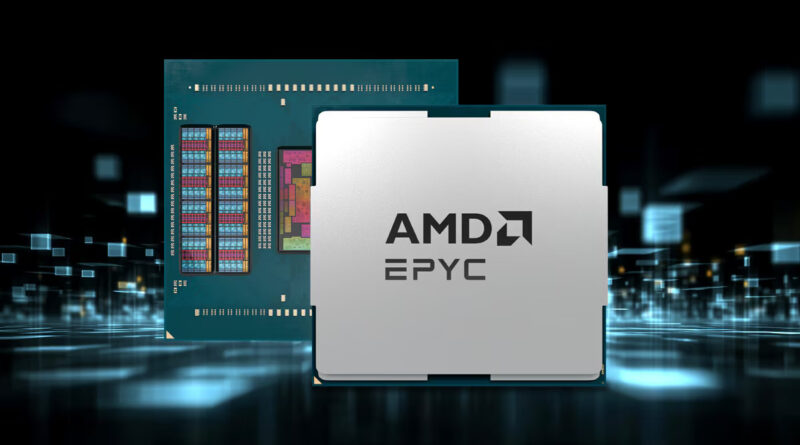
AMD EPYC Sets the New Standard for Cloud Compute in 2025
AMD EPYC Sets the New Standard for Cloud Compute in 2025
AWS, Microsoft Azure, Google Cloud, and Oracle Cloud Infrastructure all expanded their EPYC-powered offerings last year, rolling out new instances optimized for AI, high-performance computing, databases, and general-purpose workloads. The momentum shows no sign of slowing in 2026.
Amazon Web Services has gone as far as stating that AMD EPYC–based instances now deliver the highest x86 performance in the AWS cloud, underscoring a broader industry shift toward performance-per-watt efficiency, scalability, and workload specialization.
A Cloud Ecosystem Converging on AMD
What appears to be a long list of isolated cloud launches is, in reality, a single trend. Across hyperscalers, OEMs, and fast-growing AI clouds, demand for AMD EPYC CPUs continues to accelerate.

Cloud providers are turning to AMD for higher throughput, better energy efficiency, advanced security features, and flexible scaling, enabling workloads that were previously locked to on-premise infrastructure to move fully into the cloud.
AWS and AMD: Pushing x86 Performance Forward
AWS has been deploying EPYC-based instances since 2018, but 2025 marked a major leap with the rollout of 5th Gen AMD EPYC–powered EC2 instances.
Amazon introduced multiple instance families tuned for specific workloads. EC2 C8a instances delivered a 33% increase in memory bandwidth over the previous generation, while EC2 X8aedz instances doubled compute performance compared to second-generation Intel Xeon x2iezn instances—significantly accelerating electronic design automation (EDA) workloads.
Additional launches included R8a for memory-intensive workloads, Hpc8a for high-performance computing, and M8a for balanced, general-purpose use cases. Together, these instances allow enterprises to migrate performance-heavy workloads to the cloud with improved speed, flexibility, and cost efficiency.
Google Cloud Expands EPYC Across VM Families
Google Cloud also deepened its EPYC deployment in 2025, integrating 5th Gen AMD EPYC processors across its C4D, N4D, H4D, and G4 virtual machine families.
These VMs target everything from enterprise applications and web services to AI and HPC workloads. Google reports up to 80% higher web server throughput on C4D VMs versus the prior generation, while N4D VMs offer up to 3.5x better price-performance compared to N2D.
For technical computing, H4D HPC VMs deliver more than 12,000 GFLOPS of whole-node performance and over 950 GB/s of memory bandwidth, enabling large-scale simulations and data-intensive workloads. Confidential computing options further allow sensitive workloads to run securely in shared environments.
Microsoft Azure Broadens EPYC Adoption

Microsoft Azure continued its aggressive expansion of EPYC-based services, rolling out Dasv7, Easv7, and Fasv7 VM families with up to 130% generational gains in web application performance.
For HPC workloads, the HBv5 VM delivers 6.6 TB/s of memory bandwidth, while Lasv4 and Laosv4 storage-optimized VMs provide low-latency local NVMe storage for data-heavy applications. Azure also expanded GPU-backed workloads with NVads V710 v5 VMs.
Security remains a key differentiator. Azure’s confidential computing portfolio, powered by AMD Secure Encrypted Virtualization (SEV), isolates AI models and sensitive workloads in hardware-based trusted execution environments. Today, all major cloud providers deploy AMD SEV at scale, forming the industry’s most mature confidential computing ecosystem.
Azure also introduced Microsoft SQL Server 2025 running on AMD EPYC, targeting mission-critical database performance with improved efficiency.
Oracle Cloud Targets Enterprise and AI at Scale
Oracle Cloud Infrastructure leaned heavily into AMD EPYC for enterprise and data-centric workloads. Its E6 VM and bare metal instances, powered by 5th Gen EPYC, provide a high-performance foundation for large, distributed systems without requiring architectural changes.
Oracle’s Flex VM shapes allow enterprises to allocate compute and memory precisely as workloads scale. At the data layer, Oracle Exadata Database Service and Autonomous Database running on EPYC enable consistent performance across on-premise, OCI, and even multi-cloud deployments.
By standardizing on AMD architecture, Oracle has delivered a unified compute and database platform optimized for scalability, efficiency, and cost control.
The Future of Cloud Runs on AMD
Across hyperscalers, enterprises, and emerging AI-first cloud providers, AMD EPYC has become a core pillar of modern cloud infrastructure. Providers are choosing AMD not just for peak performance, but for energy efficiency, total cost of ownership, and long-term scalability.
As cloud workloads grow more complex—spanning AI, HPC, analytics, SaaS, and confidential computing—the need for a flexible and powerful compute foundation becomes critical. AMD EPYC is increasingly filling that role.