
OPPO, Google Cloud Deepen AI Partnership, Lay Groundwork for Next-Gen AIOS
OPPO, Google Cloud Deepen AI Partnership, Lay Groundwork for Next-Gen AIOS
As smartphones evolve from utility devices into full-time intelligent companions, OPPO is outlining its vision for a next-generation AI Operating System, built around two core pillars: Memory Symbiosis and Privacy Protection.
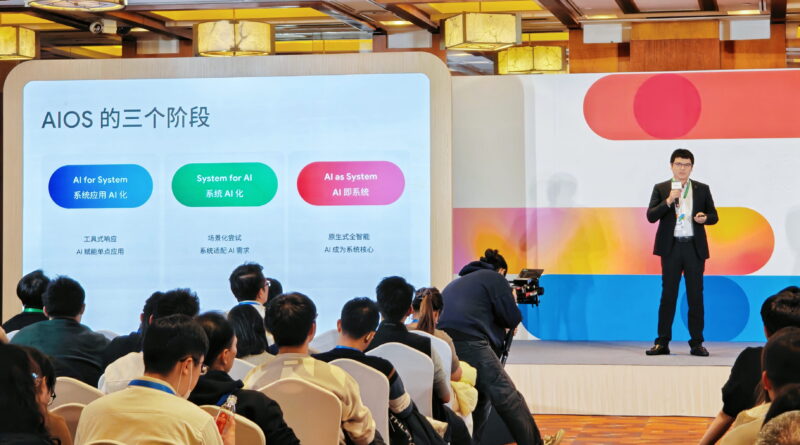
At the Google Cloud Export Summit in Beijing, OPPO detailed how its deepening collaboration with Google Cloud will shape a more native, system-level AI experience. One designed to understand users, retain context, and anticipate needs without compromising data security.
“The essence of AI is understanding the user,” said Haonan Lu, Head of Large Model Algorithms at OPPO. “Together with Google Cloud, we are shaping OPPO AI into a truly personalized intelligent companion—one that understands, anticipates, and serves users in a powerful yet intuitive way.”
Building AIOS Around Memory, Search, and Anticipation
Despite the rapid rollout of AI features across smartphones, OPPO identified three persistent user challenges: retaining information, finding it later, and knowing what users will need next. OPPO’s answer is a system-level AIOS where memory is not an add-on, but a core layer.
At the center of this approach is AI Mind Space, a global feature positioned as the system’s “second brain.” It stores and organizes information from text, images, and voice interactions, enabling long-term contextual understanding across apps and use cases.
Built using Google Gemini, AI Mind Space allows OPPO devices to surface personalized answers based on locally stored memories. To improve retrieval, OPPO and Google Cloud have also upgraded AI Search. It enables users to query content across apps using natural, conversational language.
For proactive intelligence, AI Suggest combines real-time, on-device context with stored memory data to generate timely recommendations. Together, AI Mind Space, AI Search, and AI Suggest form a connected loop—retention, retrieval, and anticipation—powered by shared memory while operating within strict privacy controls.
Privacy-First AI Through Cloud Collaboration
As AI becomes more embedded in daily routines, OPPO emphasized that privacy is foundational, not optional. To support cloud-based intelligence without exposing user data, OPPO introduced its Private Computing Cloud architecture.
PCC operates as a globally distributed, end-to-cloud system that leverages Google Cloud’s Confidential Computing. It allows data to be processed without being visible—even to cloud providers. This ensures that AI services can scale without compromising user trust.
Toward an Open, Agent-Driven AI Ecosystem
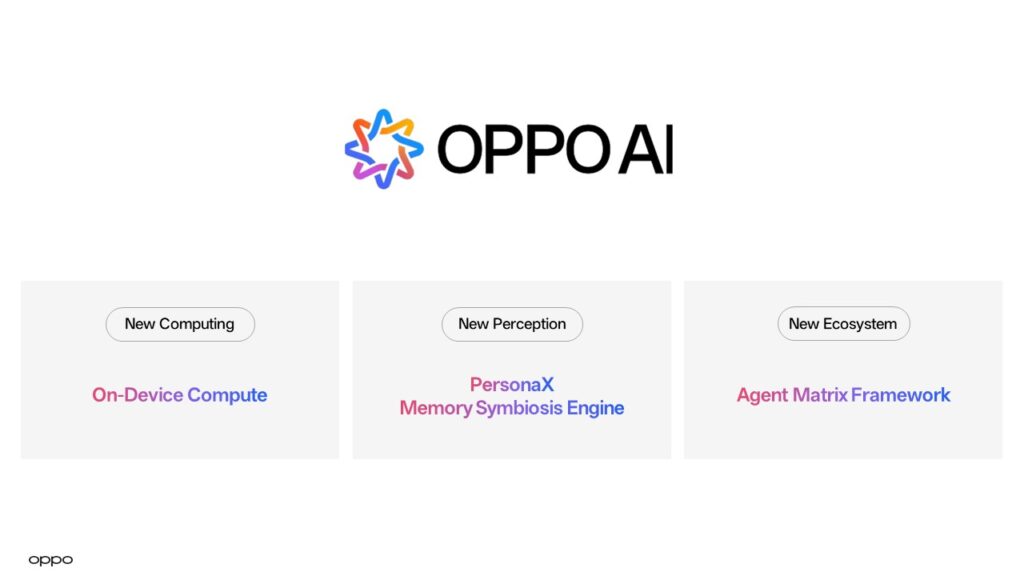
OPPO’s broader AI strategy is anchored on New Computing, New Perception, and New Ecosystem, supported by three technical pillars: on-device computing, the PersonaX memory symbiosis engine, and the Agent Matrix framework.
Through open collaboration, OPPO is pushing for Agent-to-Agent interoperability, enabling AI agents across platforms and apps to work together seamlessly. Its partnership with Google Cloud highlights this direction, aiming to break down app silos and build a cross-scenario intelligent service network.